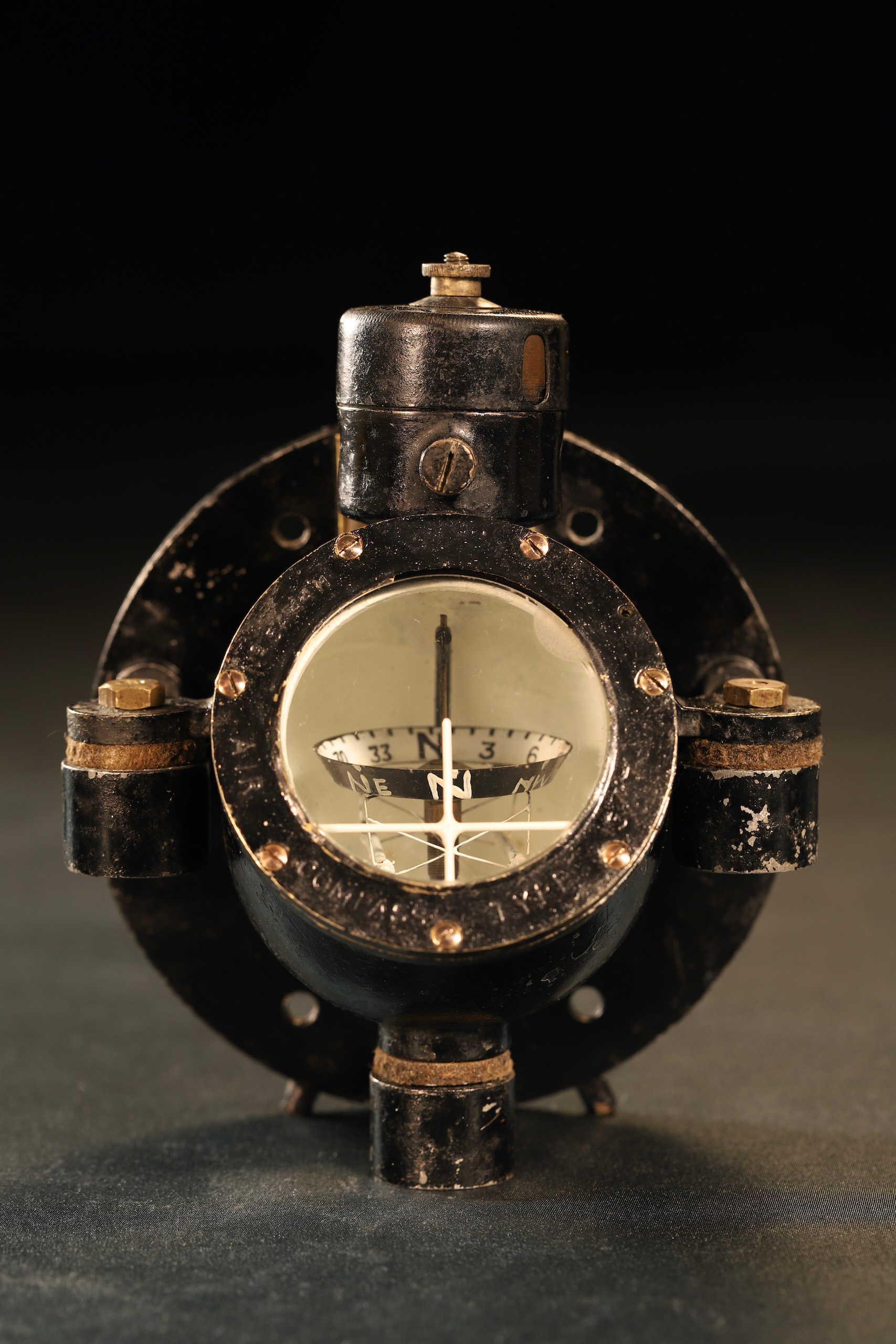
A WWI Royal Flying Corps Creagh-Osborne Type 5/17 Air Compass, Serial No 54144H by H. Hughes & Son, London c1916
A good fluid damped aircraft compass, constructed principally in bronze and aluminium, and comprising: sealed spring-suspended and felt pad-damped compass bowl; 2¼” viewing port; floating enamelled skeleton card with bar magnets below, calibrated in degrees with cardinal points; cardinal reciprocals to the outer face; front mounted cross stadia; lower mounted drain port to rear. Calibration and swinging box over having removable lid with access port.
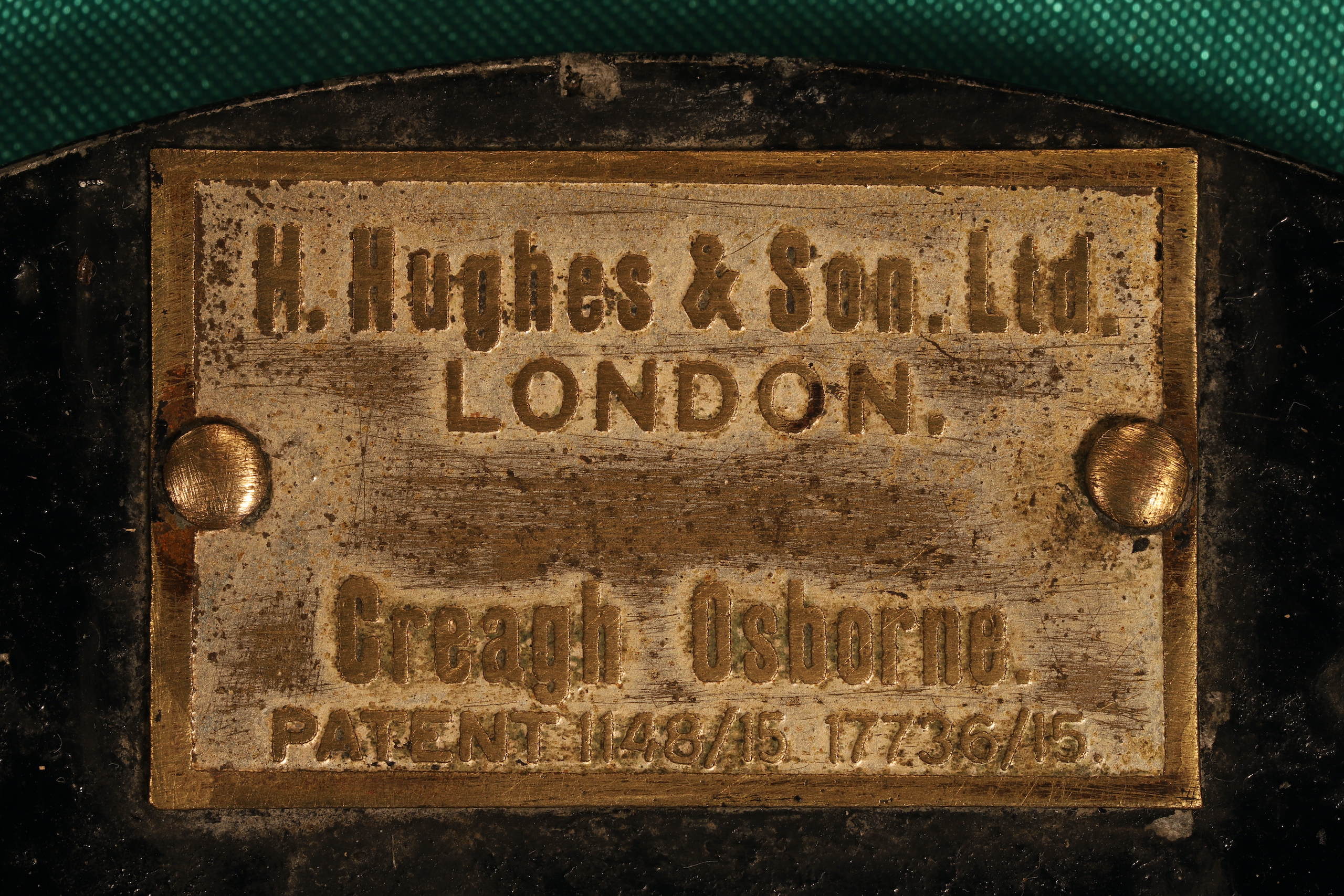
The whole mounted to its original circular cast aluminium bracket with maker’s plate bearing “H. Hughes & Son Ltd, London, Creagh-Osbourne Patent 1148/15, 17736/15.”
Condition: Probably overhauled at an early date, essentially remaining in original condition, though lacking fluid. The subject of a strip down, inspection and re-seal, the stadia and glass to bezel main body seal replaced. Some losses to external painted finish, the bezel with loss to inner edge abutting glass. Signs of oxidation to aluminium parts. The compass swings with high sensitivity easily finding north.
Comments: Very rarely seen especially in complete and working condition, of those encountered condition is generally poor and the instrument often missing its mount. These early WWI compasses were to be found in Sopwith Camels, as well as other RFC and RNAS aircraft.
Captain Frank Creagh-Osborne (1867-1943) was a pioneering inventor and Superintendent of Compasses at the British Admiralty who contributed significantly to the development of navigation technology for both maritime and aerial applications. Creagh-Osborne’s career began in the Royal Navy, which he joined in 1881. Over the years, he became a leading figure in compass innovation, introducing numerous advancements that improved the accuracy and reliability of navigational instruments. His expertise was instrumental in the transition from traditional maritime compasses to those suitable for the unique challenges of aerial navigation.
Dimensions: 5½” wide x 6¾” high x 4” deep
Stock No: SI3065
Price: Vavasseur Archive - not currently for sale