A very rare and large late 18th century French surveyors compass with sighting tube in mahogany case c1790
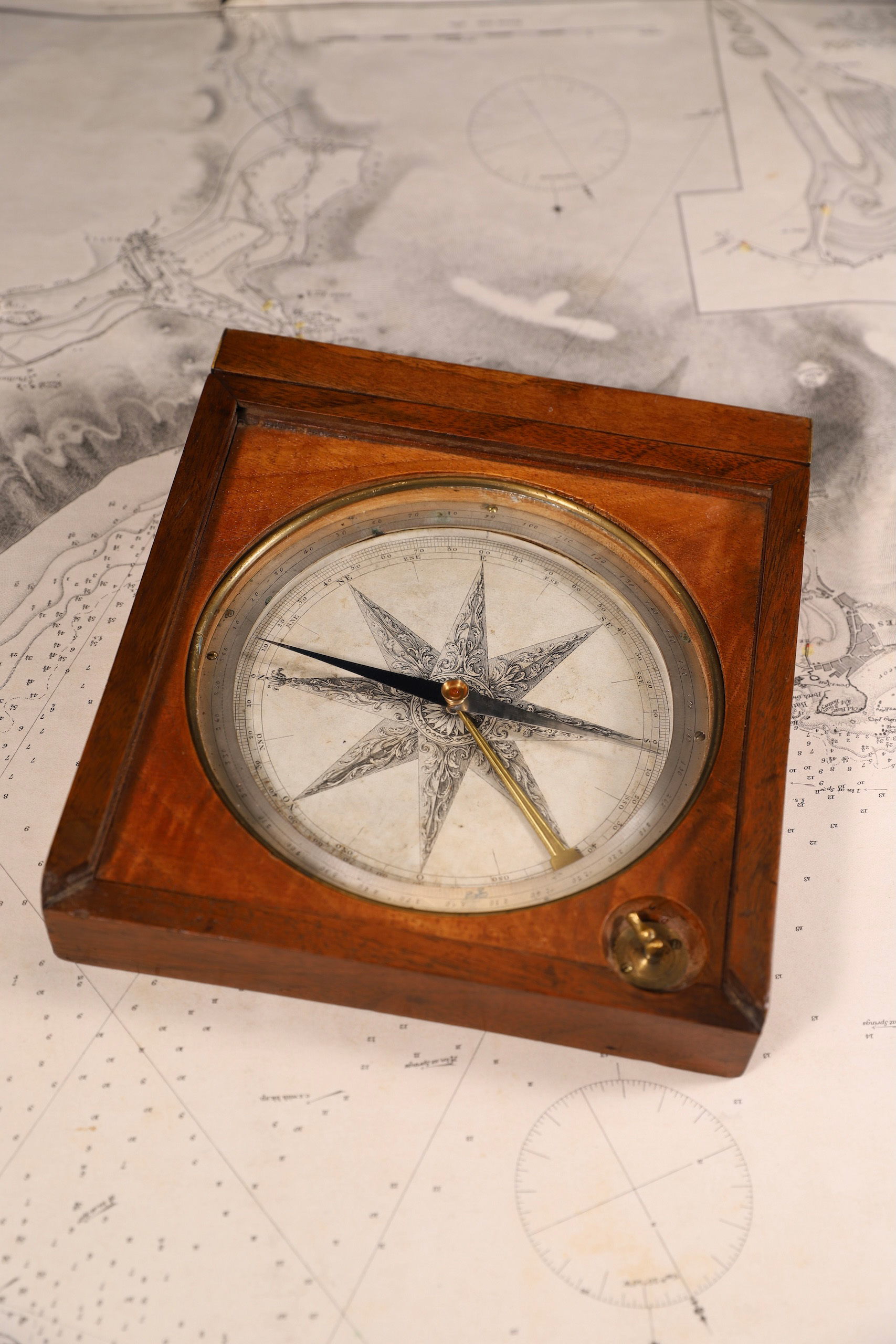
A large late 18th century French surveyor’s compass in its original mahogany case, with a finely engraved wind rose, a winder-operated needle lock and a swivelling sighting tube.
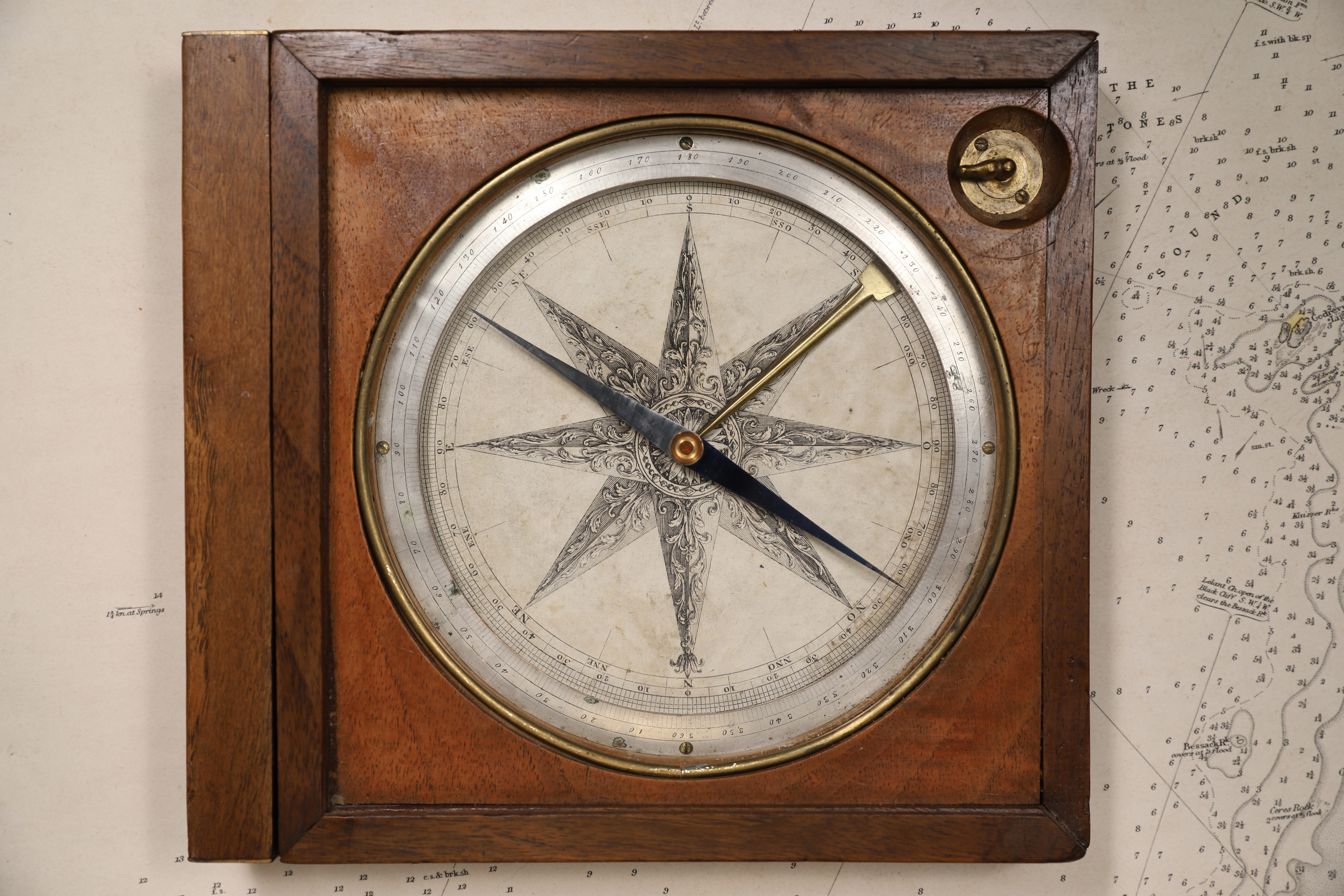
The 6″ vellum dial has an eight-pointed wind rose decorated with acanthus scrollwork, and a fleur de lys marks north. The points are lettered in the French style, with O (Ouest) for west, and include the cardinals, intercardinals and false points. An outer quadrant scale reads 0°–90°–0°–90°–0° and is finely divided to 5° and 1°. Around the dial, a separate stepped and silvered azimuth ring is graduated 0–360° in 1° increments.
The French pattern blue and bright steel needle is suspended on a jewelled pivot and a brass transit lock raises the needle from the pivot for carrying. The lock is activated by a small brass winder set into the corner of the case, which raises or lowers the lock over several turns. Original flat glass is held in place by a split brass ring.
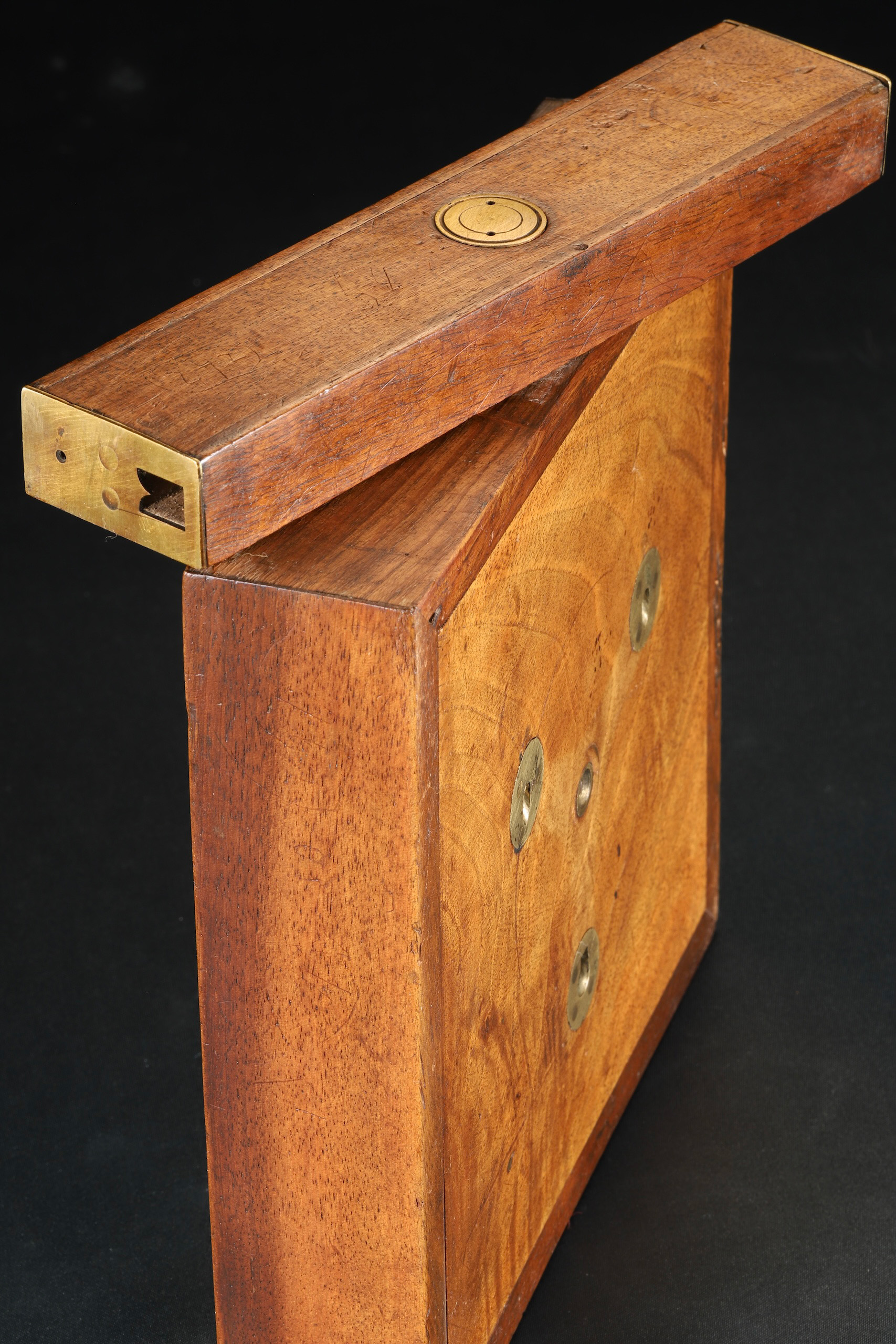
The mahogany case has a sliding lid. A double-sight alidade, a mahogany sighting tube with brass ends, is fixed to one side and swivels for taking bearings. The base of the case has brass sockets for mounting the compass on a staff or tripod.
Condition: Some ageing to the dial, and small spots of verdigris on the azimuth ring. The flat glass with light marks, the case has scratches, knocks and wear from age and use. Numbers, including 267, are hand-scratched on the case. The needle swings freely and settles, and the lock and alidade work smoothly.
Comments: This surveyor’s compass, or boussole d’arpenteur, was used to take bearings when measuring land and drawing up plans. Mounted on a staff, it was aimed at a distant point through the sighting tube, and the bearing was read from the dial.
The same instrument was used to teach surveying in French military schools, where map drawing and fortification were part of the course. The Musée national des châteaux de Malmaison et Bois-Préau holds a very similar compass that belonged to Napoleon Bonaparte, who used it whilst a pupil at the École Royale Militaire at Brienne from 1779 to 1784.
Early examples are scarce. Those recorded, including ones signed by Lerebours and by Vincent of Paris, to be found in the Lerebours listing on the compassmuseum.com website, share the same form: a wooden case with a sliding lid, an alidade or sighting tube that swings out from the side, and an engraved dial within an azimuth ring. The Bonaparte and Vincent compasses both have a simple sliding transit lock, whereas the more sophisticated winder on this compass suggests a slightly later date.
Surveyors compasses of this period rarely survive complete. This one keeps its original case, lock mechanism and sighting tube. It is a large example, with a particularly fine engraved compass rose and a more advanced lock than the Bonaparte compass.
One of the best examples we’ve seen, this is absolutely a piece for the compass collector and connoisseur alike.
Dimensions: 7½" wide x 8¼" deep x 1½" high
Stock No: SI3190
Price: £1500