An extremely unusual possibly prototype mining barometer no. 6345 with anti-parallax mirror by J.H. Steward c1915
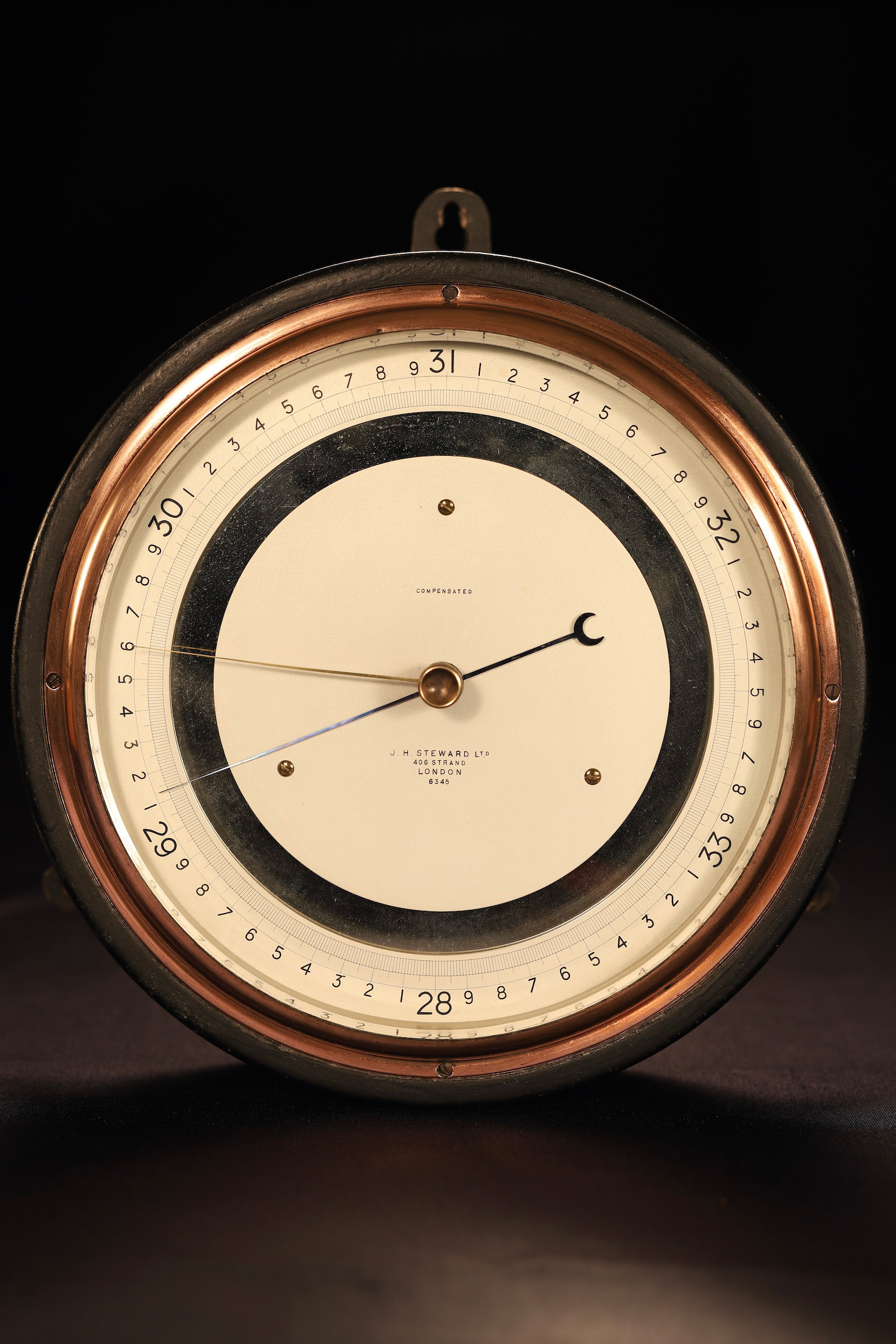
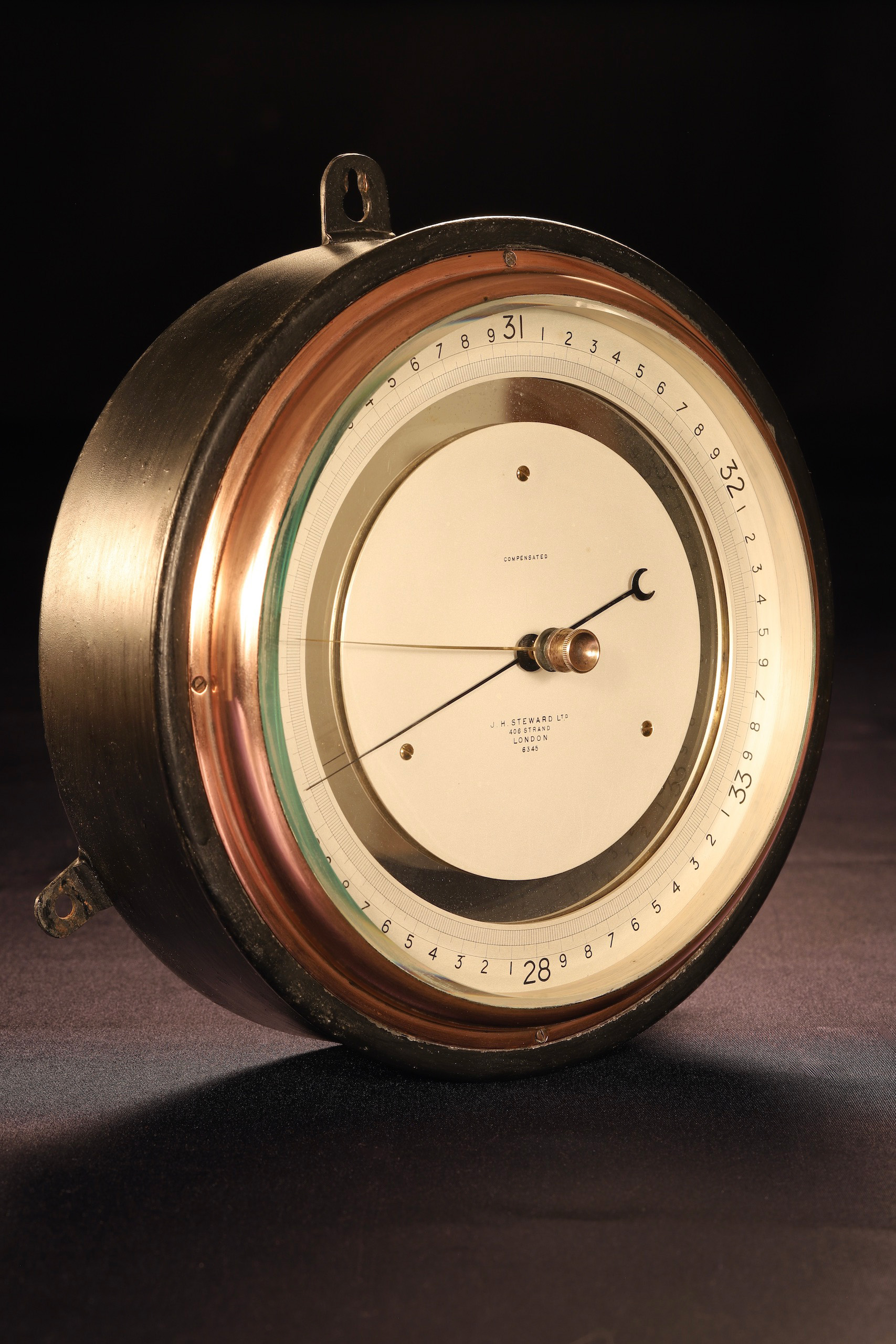
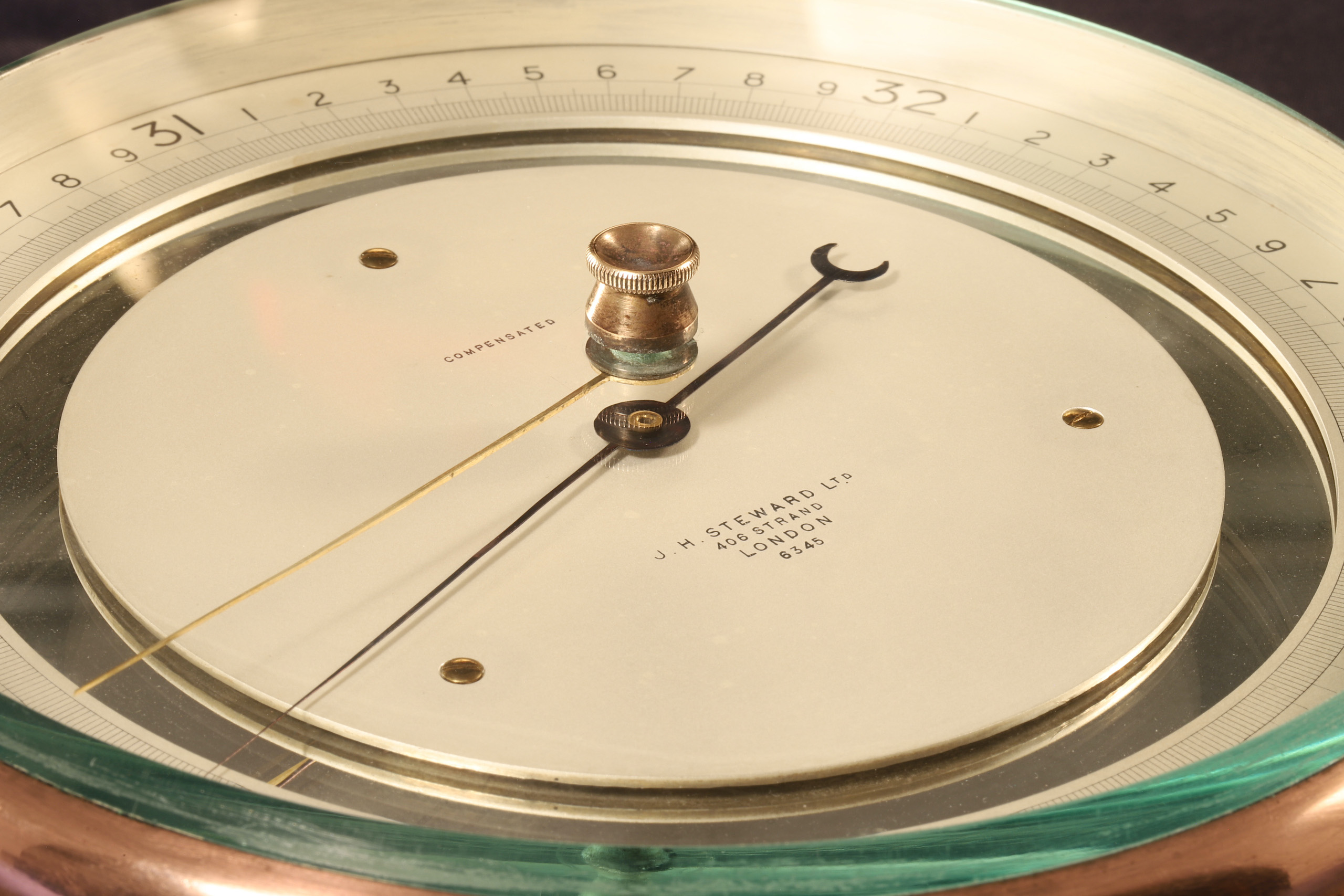
Aneroid barometer having 6¼” three piece silvered and engine divided dial, the outer barometric scale calibrated in inches of mercury with a range from 28” – 33” divided down to 1/100”, anti-parallax mirror, inner portion marked “Compensated,” the lower part with maker’s name “J.H. Steward Ltd,” “406 Strand,” and serial no. “6345.” Very fine tapered and blued steel pointer, gilt brass index, heavy bevelled glass.
The heavily modified standard pattern Vidie movement driven from a single 2¾” nickel alloy soldered capsule tensioned on a C Spring. Extended drop links, raised primary lever, sub chassis (numbered “35”) with spindle and gain adjustment, case mounted with stand offs.
The whole contained within a flanged zinc drum form case, the verso with tri-fixing points and calibration port.
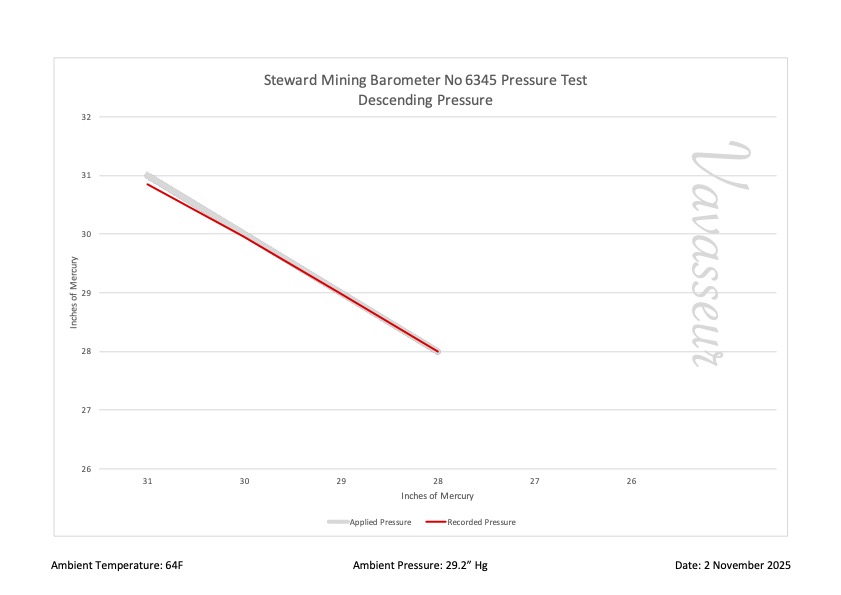
Condition: The subject of a full service, conservation, and calibration under laboratory conditions, see performance chart from dynamic test. The movement working well with good sensitivity, observed diminishing accuracy at higher pressures greater than 30.75” Hg – this is a characteristic of earlier pressure capsules and contingent upon the then metallurgy which over time becomes less flexible.
The dial very good with only minor signs of age, the mirror with some minor deterioration. The case probably historically re-painted.
Comments: This is a particularly interesting instrument, perhaps amongst the first to employ an anti-parallax mirror. This enabled very accurate setting of the index ensuring the optical axis of the eye lay at exactly 90° to the plane of the dial, affording precise positioning of the index above the pointer.
The movement, numbered “35,” would very much suggest limited or prototype production within the wider Steward serial number range (“6345”). This is the first of this type of instrument seen, and we are not aware of any period reference to this type. Anti-parallax mirrors became known and fitted to grade one instruments in the late 1920s, and Negretti & Zambra illustrate such a system in its M2 catalogue which dates to the mid-1930s.
Based on what at the time would have been a fairly standard Steward movement, this instrument is notable for some clear departures from that standard, and the cock has a number of irregularities at its base, suggesting issues with positioning, probably a product of adaption. The makers seem to have intended the movement to attain greater dimension in a vertical plane, hence extensions to the working height of key components, the primary lever, cock and arbor carrier. The sub chassis carrying the spindle is an altogether a unique arrangement, peculiar in that it affords no or little adjustment to end shake suggesting very precise setting in manufacture. None of the aforementioned is consistent with mainstream production.
The dial is in three parts, the centre and barometric chapter ring constructed in heavy gauge brass, the anti-parallax mirror a glass mirror disc. The image showing the verso details the two sets of fixings, those holding the chapter ring to the mirror with machine screw secured clips, the centre held to the glass with three machine screws and threaded ferrules.
Interestingly, although a minor detail, the bezel though generically brass, has an unusually high copper content for anything other than an earlier rather than later instrument.
The application is certainly for mining, and it will be appreciated that this barometer was intended to be extremely accurate. Precisely why such an instrument would be required can only be conjecture, however this period in history was particularly precarious as deeper and deeper mines were opened. After many accidents related to the egress of toxic and noxious gasses from the surrounding rock, it might have been deemed appropriate for more accurate studies and monitoring of the prevailing conditions. This instrument would have been ideal for such tasks.
A significant and very interesting piece.
James Henry Steward (1817–1896) established J.H. Steward in London in 1852 and the company became incorporated as J.H. Steward Limited on 1st February 1913. The company produced a large range of items for military use and advertised in its catalogues that they produced instruments for ‘Reconnoitring, Sketching, Night Marching, Signally, Gun Laying’. They were well thought of with their work to such a standard that they were opticians to ‘The British & Foreign Governments, the National Rifle Associations of England, Ireland, India, Canada & the Colonies, and the National Artillery Association.’
Dimensions: 8" diameter x 2¾" deep
Stock No: BA3014
Price: Vavasseur Archive - not currently for sale