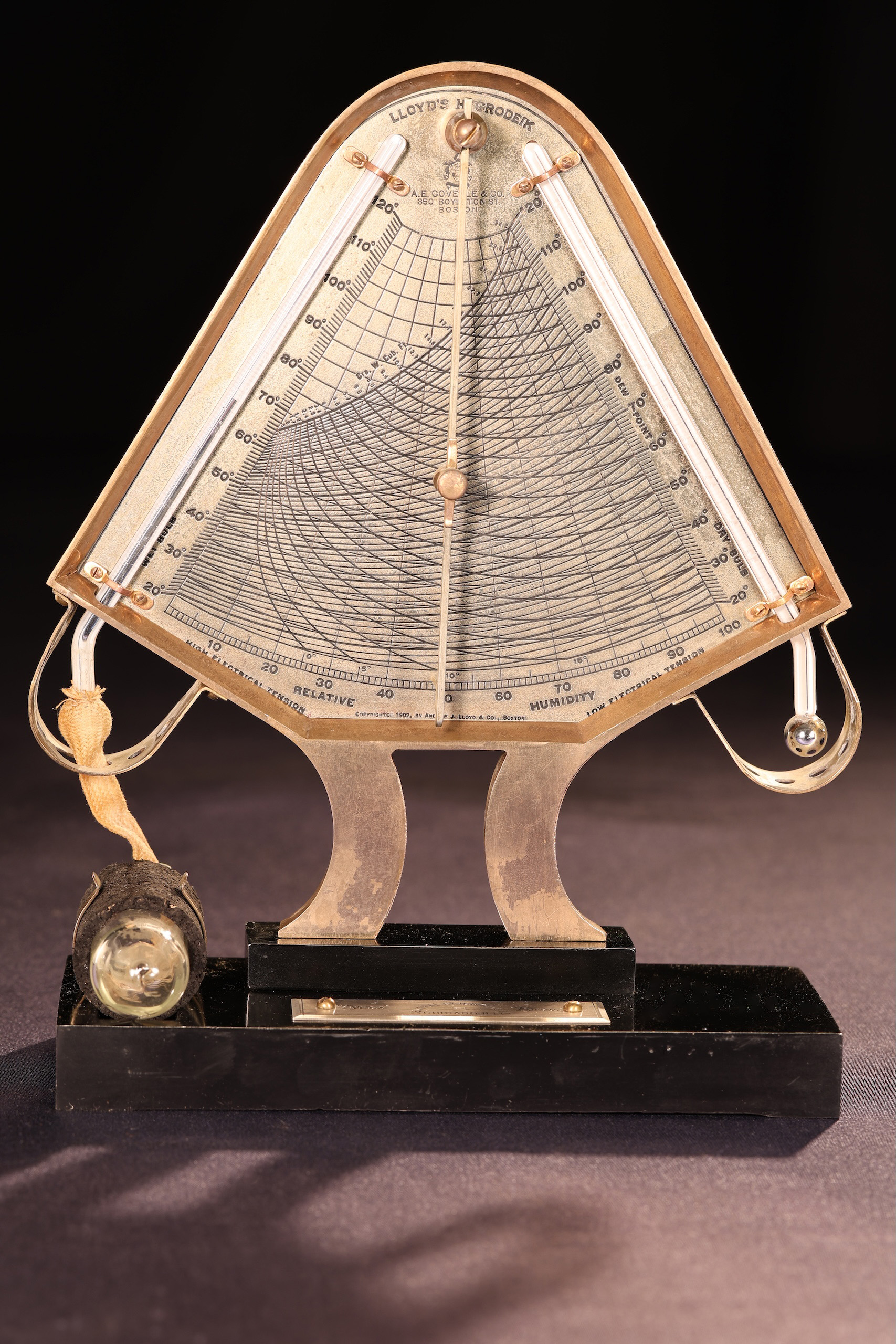
An early twentieth-century Tycos Lloyd’s Hygrodeik desk or laboratory work bench hygrometer by Taylor Instrument Companies, USA c1910
An early twentieth-century desk hygrometer for measuring relative humidity, dew point and the moisture content of air. The engraved chart is signed “Lloyd’s Hygrodeik” and “A. E. Covelle & Co., 350 Boylston St., Boston”. It is also marked “Copyrighted 1902, by Andrew J. Lloyd & Co., Boston”. The ebonised base carries a Central Scientific Co., Chicago plaque with the Tycos trade name of the Taylor Instrument Company.
Two Fahrenheit thermometers, reading 20° to 120°, flank a fan-shaped chart of intersecting curves. The left-hand thermometer is the wet bulb. Its bulb is wrapped in a cotton wick that runs down into a glass water reservoir in a cork sleeve. The right-hand thermometer is the dry bulb.
A hinged index arm with a sliding pointer is set at the junction of the two readings. The arm then shows the relative humidity on the scale at the foot of the chart, from 10% to 100%. Further curves give the dew point and the weight of water vapour in grains per cubic foot of air. The thermometers are held in sprung clips and guarded by curved metal loops.
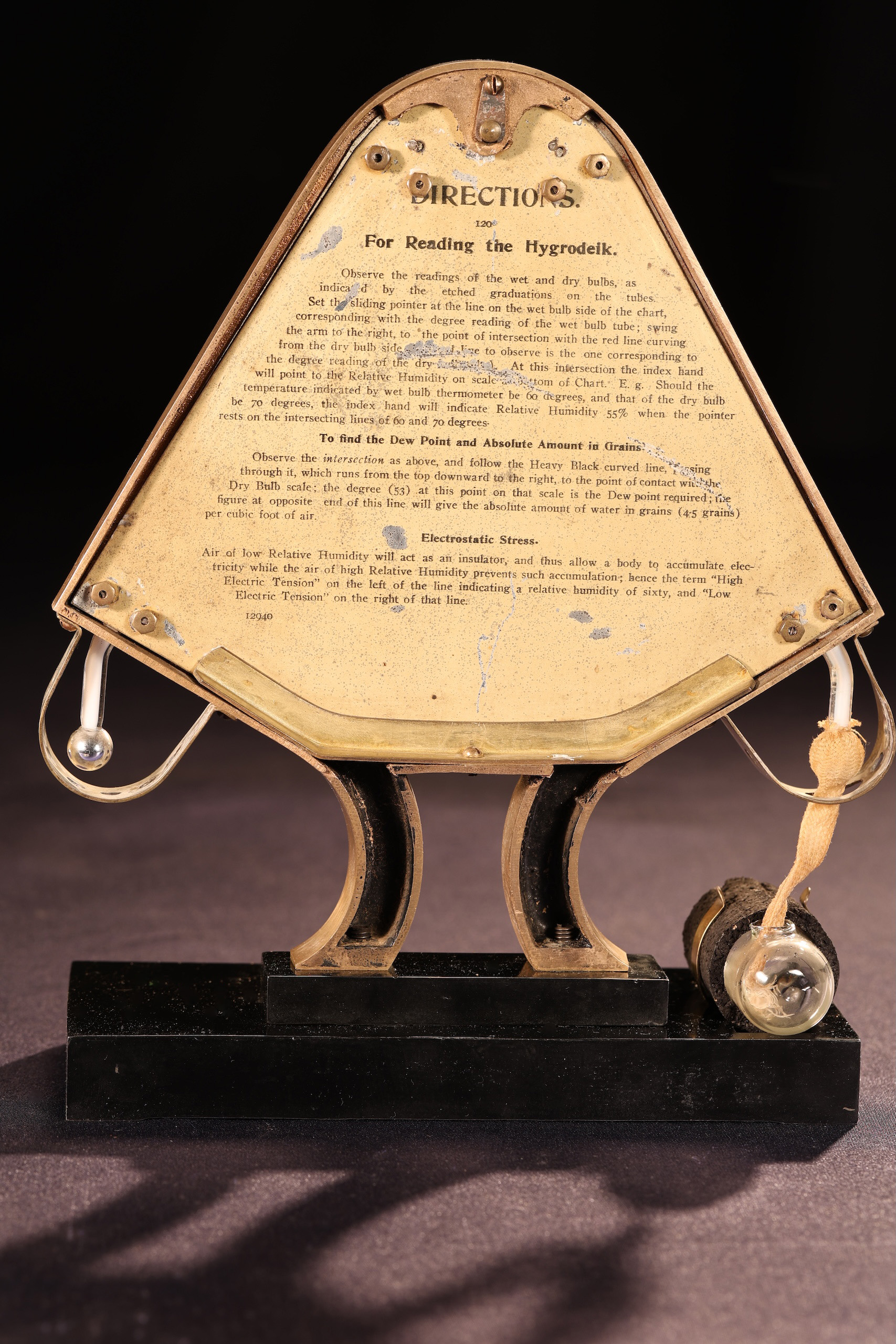
The reverse has the original printed directions for use, numbered 12940. These include a worked example: a wet bulb reading of 60° and a dry bulb reading of 70° give a relative humidity of 55%. A final section, “Electrostatic Stress”, explains the “High Electrical Tension” and “Low Electrical Tension” markings on the chart. Dry air acts as an insulator and lets static build up, while humid air prevents it.
Condition: Both thermometers intact. Ageing to silvering on front and some losses to instructions on verso.
Comments: The Hygrodeik name goes back to the “Graphic Hygrometer or Hygrodeik” patented by Nathaniel M. Lowe of Boston in 1878. Andrew J. Lloyd & Co. were Boston opticians, and the chart was copyrighted in their name in 1902. The instruments were made by the Taylor Instrument Companies of Rochester, New York, who traded as Tycos from 1908 to 1932.
A. E. Covelle & Co. were Boston opticians, listed at 128A Tremont Street in 1905 and at 350 Boylston Street by 1919. The Central Scientific Company of Chicago supplied scientific apparatus to laboratories and schools.
An unusual and very collectable scientific instrument from the early 20th century.
Dimensions: 8⅝" wide x 10¾" high x 3¼" deep
Stock No: SI3401
Price: £650