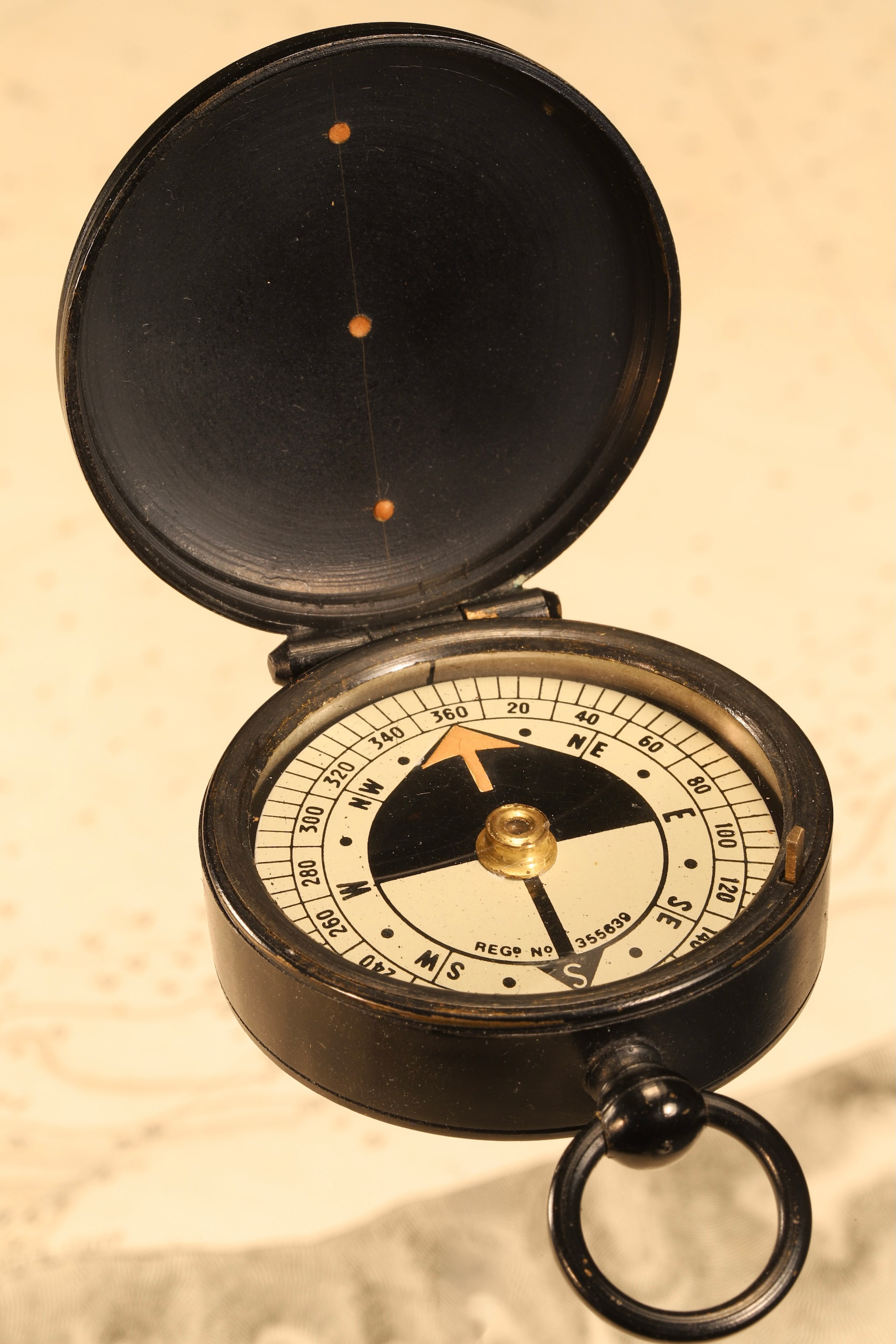
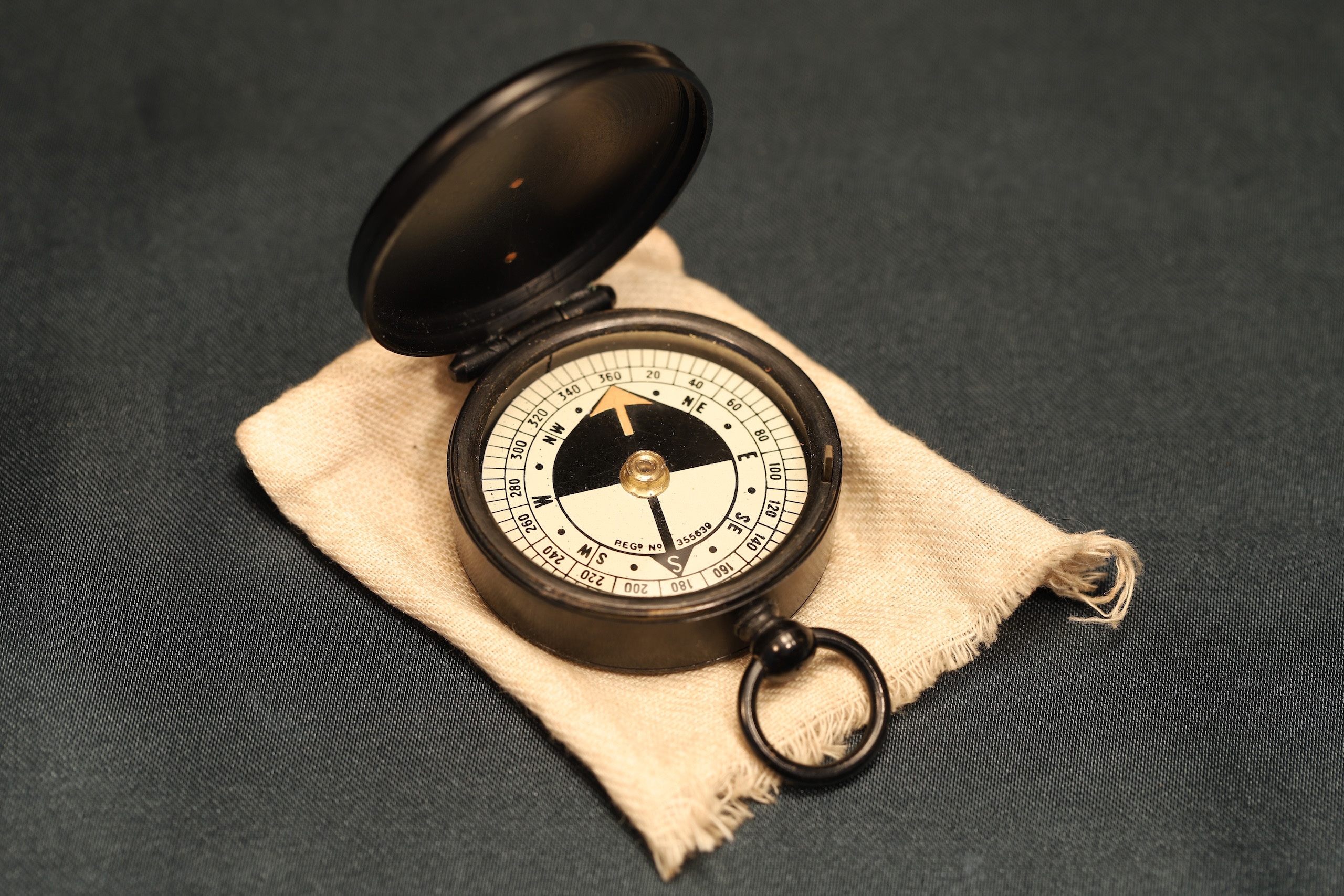
An antique Francis Barker hunter cased pocket compass, registered design no. 355639, in original cloth bag c1900
Francis Barker registered this distinctive dial pattern in 1900 — three years before he registered the better known Royal Geographical Society Pattern dial of 1903. The two designs share certain characteristics, and this earlier pattern can reasonably be seen as a precursor to the RGS Pattern, but they are distinct registered designs and should not be conflated.
The Compass
An antique Francis Barker hunter cased pocket compass with registered dial no. 355639, circa 1900.
The 1½” floating aluminium card is hand decorated and carried on jewelled suspension. The design is immediately striking — a bold black and white dial with the 0°–360° outer scale divided to 5° and marked with cardinals and intercardinals, dots indicating the false points, and a large orange north arrow on a black surround dominating the upper half of the card. The registered design number 355639 appears to the lower centre. Low dome crystal.
The whole is contained within a japanned brass hunter case with pendant and bow. The inner lid carries a lubber line with three orange dots — almost certainly highlighted in Balmain’s luminous paint, an early luminous compound widely used in instrument making from the late Victorian period before the advent of radium-based paints. The lid-activated transit lock engages automatically when the case is closed.
Accompanied by its original soft cloth bag.
The Registered Design
Francis Barker registered this dial pattern — design number 355639 — in 1900. A slightly amended version of the pattern subsequently appeared in Barker’s 1907 catalogue as “The Owl,” but this example predates that later development. The bold, functional design — clear degree markings, prominent north indicator, and luminous points — reflects the direction in which compass design was moving at the turn of the century, away from decorative Victorian compass roses towards the clean, practical dials demanded by exploration and military use.
Francis Barker
Francis Barker established his business in 1848 and went on to become the preeminent British compass maker of the Victorian and Edwardian eras, supplying the instrument trade as the dominant white label maker — his compasses appearing under many respected names, or none at all.
Condition
In wonderful condition throughout. The card is very clean, swinging freely and finding north easily. The japanned brass case retains almost all of its original finish — an exceptional result for an instrument of this age. The hinge is strong; the transit lock works correctly. The cloth bag shows some fraying and marks consistent with age, otherwise good.
Why This Piece?
A Francis Barker compass in this condition, carrying an early and distinct registered dial pattern, and with its original soft cloth bag, often missing, is a genuinely collectable piece — interesting to the Barker specialist, attractive to the general collector, and visually striking enough to appeal as a gift well beyond the collector market.
A wonderful gift for: an engagement or wedding, a graduation, a significant birthday or retirement, or anyone who appreciates the history of British exploration and instrument making.
Dimensions: 1⅞" diameter x ¾" deep
Stock No: SI3143
Price: SOLD