
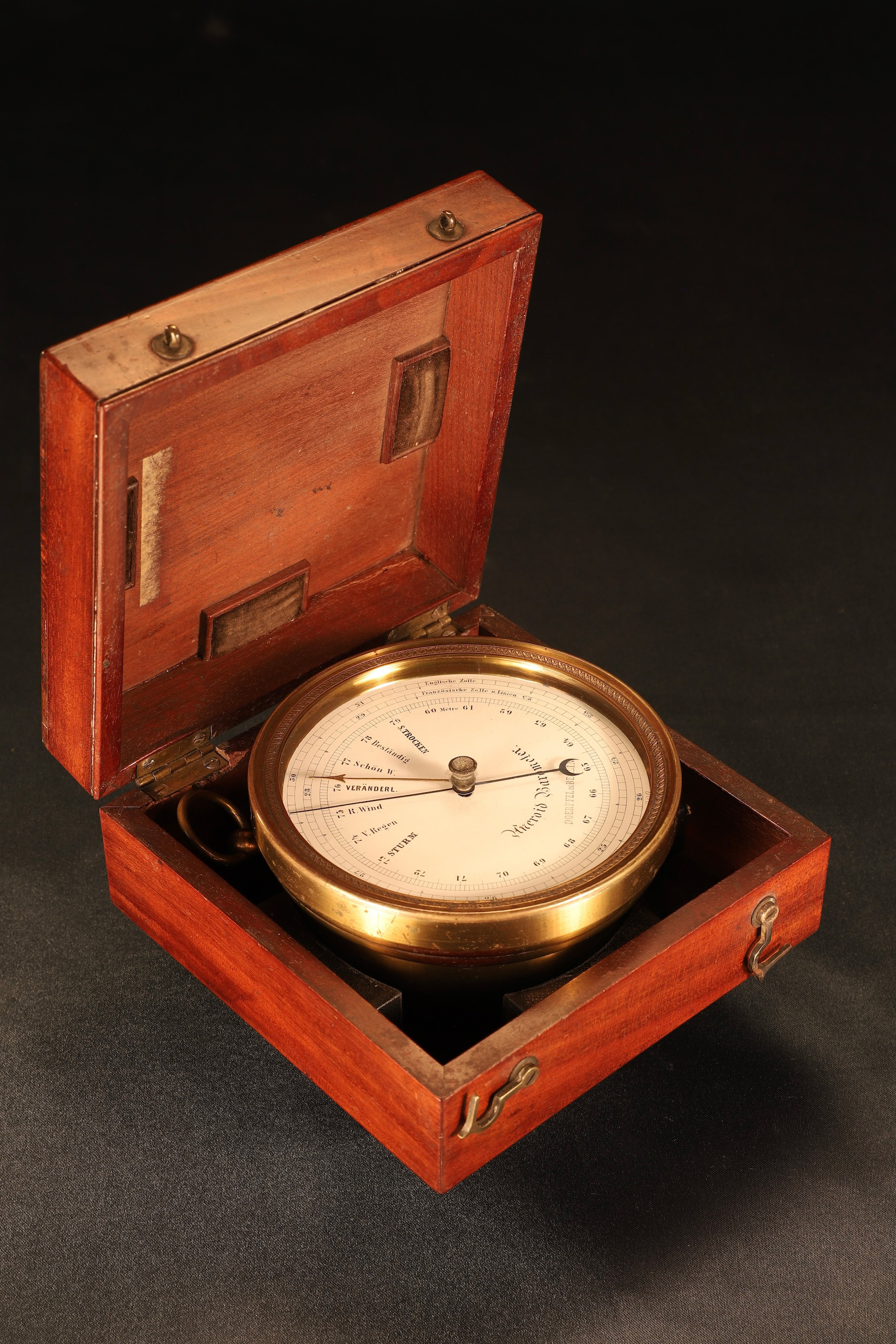
A very important early aneroid barometer retailed by Carl Theodore Doerffel, Berlin, No 200, attributed to Antoine Redier for Lucien Vidie c1846
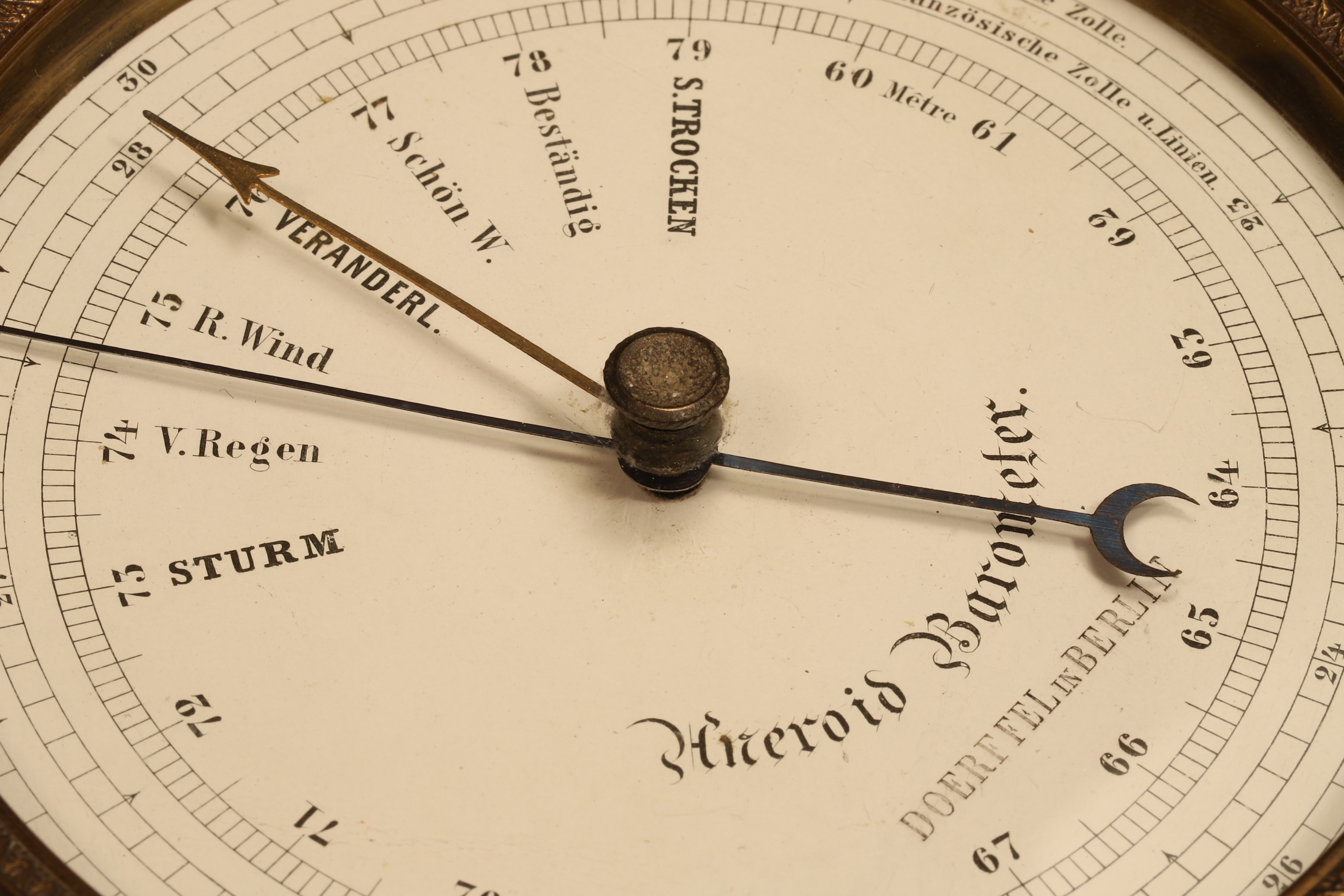
Aneroid barometer having 3⅞” printed card dial displaying three barometric scales, the outer calibrated in “English Inches” with a range from 24.5” – 31.5” divided down to 1/10”, the middle calibrated in “French Inches & Lines” with a range from 23” – 29.5” divided to 1/12”, the inner calibrated in centimetres with a range from 60cm – 79.5cm divided to 1mm. Standard meteorological terms in German to upper part, the lower part marked “Aneroid Barometer” in Gothic font and stamped “Doerffel in Berlin” below with serial no. “200” to extreme bottom edge. Blued steel pointer, gilt index, flat glas retained by a pattern struck bezel.
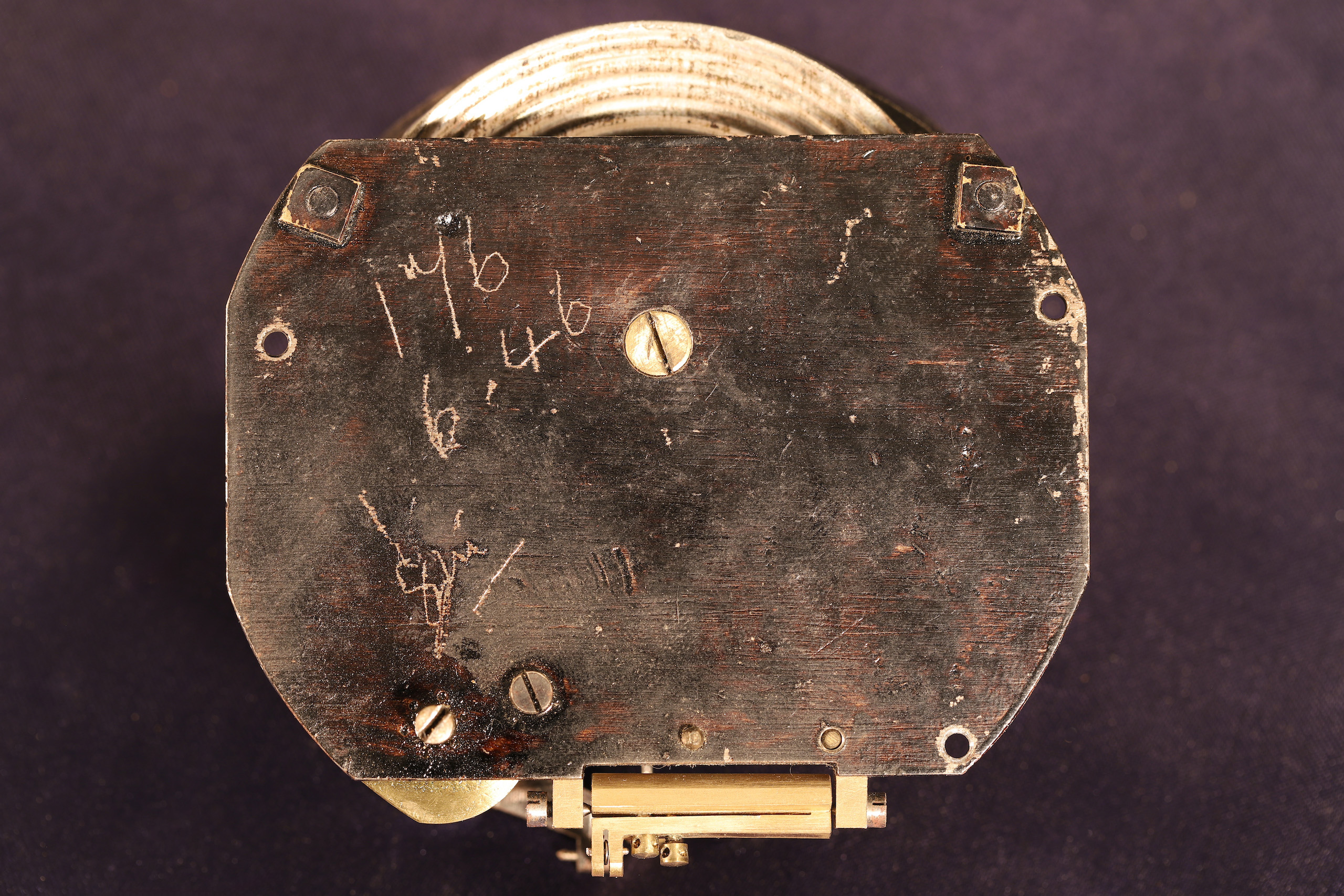
Very unusual and extremely high quality aneroid movement. Early pattern 2¾” diameter deep capsule with polished lateral anchor pin tensioned on a coil spring, substantial cast iron bridge with static mass, the cock assembly precisely cut and formed from the ‘solid,’ micro-gain adjustment and open-linked chain transmission. The movement raised over a substantial cast iron chassis, the verso inscribed “176,” “6.46” (June 1846), and “8m.”
All contained within a flared drum-form rolled and soldered case, the interior back plate with heavy ‘A’ frame bracing structure and movement pick up points.
Presented in its original mahogany, brown velvet lined travel case, retailer’s label to inner lid marked “T. Dörffel, Geprüfter Optikus und Mechanikus, Unter den Linden No 46, in Berlin.” The hinges fixed with steel screws. Swinging catch security.
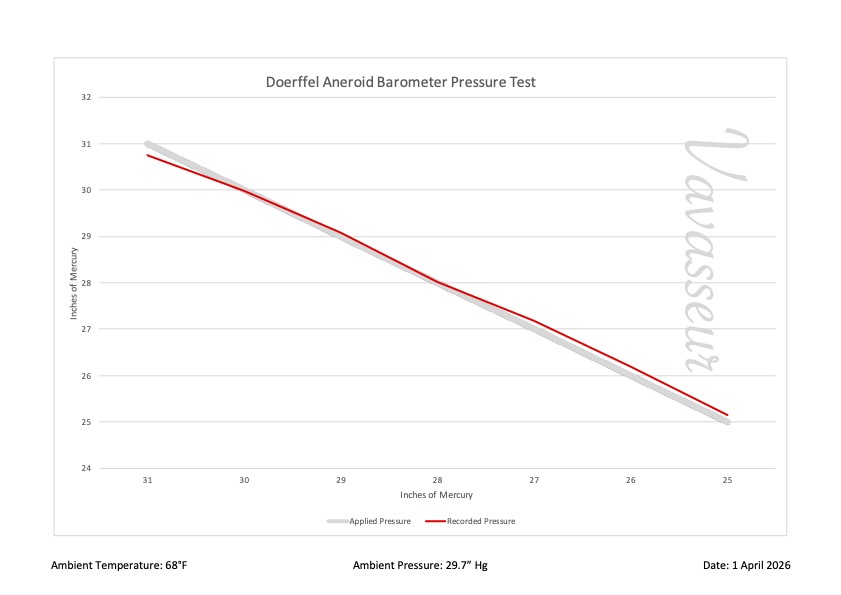
Condition: The subject of a full service, conservation, and calibration under laboratory conditions, see performance chart from dynamic test. The movement working exceptionally well with good sensitivity and stepless progression.
Generally very crisp, the dial clear and clean, some minor marks and irregularity consistent with dials of this type. The brass case retaining a very high proportion of its original lacquered finish. The travel case with some signs of damage to hinge area but structurally secure, the outer surfaces with good colour and figure, velvet lining to inner base with good colour, the lid facings worn. One swinging catch repaired.
When acquired, the glass was missing and the pointer was of a modern pattern and didn’t reach across all three scales. The glass, the pointer, and the index have been replaced with correct period examples.
Comments: This instrument has been the subject of much research, and despite chasing down all alternative avenues and theories, the evidence keeps coming back to suggest that this instrument was one of the original 100 aneroid barometer movements commissioned by Lucien Vidie from the young and upcoming clockmaker Antoine Redier in c1845 – the bottom of the chassis is dated June 1846, consistent with the Redier order.
The facts:
The design of the aneroid barometer was patented in 1844 – the date would therefore suggest manufacture either by Vidie or Redier. Not only this but the phrase “Aneroid Barometer” was part of Vidie’s patent.
The execution in making of the movement is without doubt the work of a clockmaker, quality of manufacture being much superior to the examined examples of early Vidie production.
Of particular interest is the cock, very finely executed and machined from the ‘solid’ to a pattern quite unlike the early Vidie produced instruments. The chain is also noteworthy, not the fine chain seen in almost all C19th instruments but a coarser open linked design. It is possible that this was a later repair but equally that Redier might have considered this type of chain to have better transmission qualities than the finer linked chain that he would have been familiar with in pocket watches and other time pieces.
The dial is the only known example of an Aneroid Barometer showing a pressure range defined in “French Inches & Lines” as well as English inches and centimetres. Although the traditional mesures usuelles (customary measures) were banned from use in France from January 1840 in favour of metric, French Inches & Lines (pouce et lignes) had been used traditionally in the production of scientific instruments and particularly lenses. Germany, too, used French Inches for specific optical instruments and in scientific contexts, which may explain the use here.
Even if the inscribed date on the chassis were to be disregarded, every indication suggests a very early instrument, the capsule of the very early thicker construction obviously formed in at least three major component parts, though this example appears to be a little less refined compared to those capsules seen in early Vidie-manufactured instruments.
Our conclusion, based on much research and the physical evidence:
Vidie claimed to be dissatisfied with the quality of the instruments produced by Redier and refused to take delivery or to pay for the work undertaken. The matter went to court and Redier, supported by the eminent scientist François Arago, won the case. Lucien Vidie was instructed to pay 5000 francs, then about £200, or £31,500 today. Given that we know Lucien Vidie then set up his own workshop to manufacture these instruments, it is highly likely that, as part of this settlement, Vidie took possession of not only the 100 instruments but the patterns, dies and machinery specifically designed for these aneroid barometers.
Vidie was no skilled craftsman – which is why he went to Redier in the first place – and the first instruments he produced were much more rudimentary in construction. These would have had the added advantage of being rather cheaper to produce. He did retain the cast iron chassis which is seen in early Vidie-produced instruments, a number of which have been examined.
Although the movement of this barometer bears the serial no. “176,” and only 100 were ordered by Vidie from Redier, it is likely that more were made, to include prototypes and rejected movements. It is also possible that the numbering of instruments may have started at “100,” for instance.
In summary:
Lucien Vidie, a non-skilled craftsman, commissioned Antone Redier, a talented watchmaker, to make 100 examples of his new aneroid design. Unhappy with the results, Vidie took over production, simplifying the process to focus on the technical (and cheaper) rather than the more sophisticated (and expensive) watchmakers standard. Having spent 5000 francs to obtain these 100 barometers plus the equipment, he would have wished to recoup this loss as quickly as possible. It is almost certain – and logical – that he would have promoted this new ‘wonder instrument’ to respected scientific retailers across Europe, and Carl Theodore Doerffel was one of the most well-known of these, having recently introduced the first German-built daguerreotype camera to that market. This would also explain not only the German-language dial but the use of the three barometric scales to appeal to the widest possible market – Germany did not go metric until the early 1870s.
Although our research continues, given all the above, this is almost certainly the earliest recorded Vidie Aneroid Barometer, and its significance cannot be overstated.
Dimensions: Barometer - 5⅝" diameter x 2" deep; travel case - 5⅝" wide x 5⅝" deep x 2½" high
Stock No: BA2490
Price: Vavasseur Archive - not currently for sale