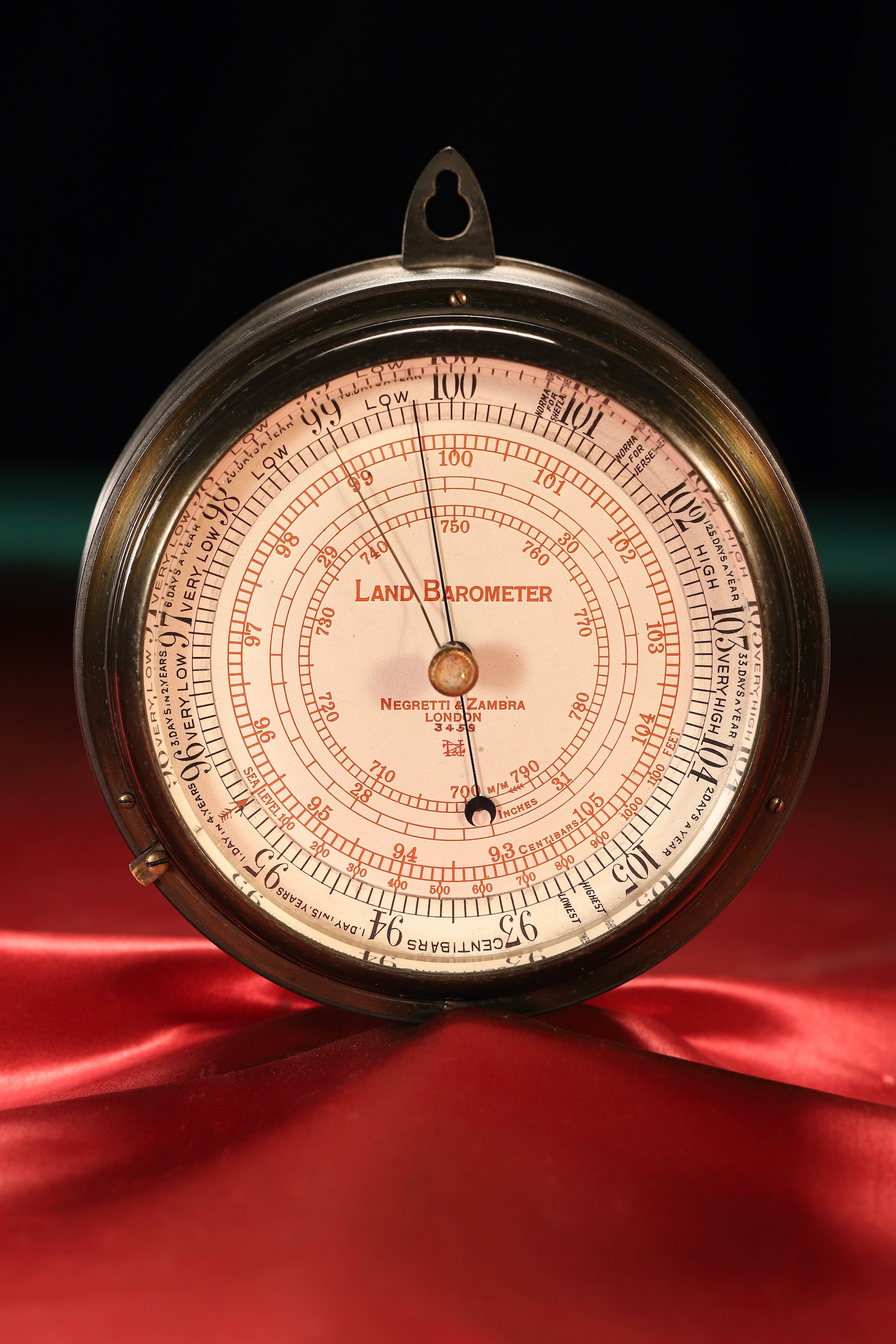


A very scarce and good oxidised brass and zinc cased “Land Barometer” no. 3459 by Negretti & Zambra c1910
Aneroid barometer having 5¼” silvered, engraved and die struck two-part dial marked in red and black wax, the outer scale calibrated in centibars with a range from 93 – 105 divided to 1/10th with notes on average values for geographic locations and time periods, marked “Centibars” with “Highest” and “Lowest” pressure values. Red arrow for altitude setting to centre lower corresponding altitude scale. The whole with rotational adjustment by bezel positioned side lever across the elevations 0 (sea level) to 1100ft.
The inner (red) scales calibrated in centibars, range 93 -105 divided to 1/10th, inches of mercury, range 28” – 31” divided to 1/10th, milimetres of mercury, range 700mm – 790mm divided to 1/10th. The centre marked “Land Barometer” and signed by the maker “Negretti & Zambra” with serial no. “3459” and “N&Z” logogram. Fine blued steel pointer, heavy bevelled glass, parallax reducing dog leg index.
The standard lacquered brass and cast Iron Vidie pattern movement driven from a single nickel alloy 2¾” soldered capsule and tensioned on a C spring, all raised over a circular chassis secured to the case back plate on three machine screws. The whole presented in a zinc drum form case with bulkhead fixings at 12 and 6 o’clock, calibration port to verso.
Condition: The subject of a full service, conservation, and calibration under laboratory conditions, see performance chart from dynamic test. The movement working exceptionally well with good sensitivity and accuracy across the range 28 – 31 inches Hg.
The dial, the outer centibar calibrated part with some marks and losses. This had, as will be seen from the images, an alternative paper scale calibrated in inHg glued to it – this paper scale is retained. The centre very good with virtually no marks or losses.
Comments: This instrument, which appears in Negretti & Zambra’s catalogue of c1915, was produced in two versions, the first with best quality movement in a 6” diameter solid brass case with bezel driven centibar scale and clamp, and this example which is listed as having a second quality movement in a spun bronzed metal case, the metal actually being zinc. They were priced at £ 4 15 0 and £ 2 10 0 respectively.
Four examples are known, including this: one, serial no. 4535, is in the Science Museum and probably dates to just post WWI; two others, one in the archive of the Met Office, serial no. 3685 and one last, serial no. 3345, are of the same type and age as the example profiled here. It is certain that these instruments were serially numbered within a range of other manufactured instruments – we will never know precisely how many of these were built but on the basis of the incidence upon which they are seen it is likely that numbers were very low indeed, perhaps well less than 100, commercial viability often being an illusory consideration, and one that might well cloud the scientific significance of the instrument.
It does appear from inspection that this was not a mass produced item and might even have been made to order only. One point of interest is that this instrument, numbered 3459 is just one instrument later than the illustration in the Negretti & Zambra catalogue instrument, 3458, strongly suggesting that this was one of the very first made.
No mention is made in the catalogue of any additional scales that may be supplied – in this case the paper scale, calibrated in inches of mercury and most certainly original, had been pasted down over the outer centibar scale. It is clear that somebody preferred this scale for one reason or another and it might well be that Negretti & Zambra were asked to provide this alternative scale as a special one-off item. It is professionally hand drawn in ink, probably by a dial maker, and clearly not a commercial proposition. It has not been left in situ for several reasons: from the perspective of conservation it was important to remove any bonding agent (probably animal glue) from the silvered surface of the centibar scale; the paper scale had become detached and was fouling the pointer; and finally one of the primary aspects of the instrument, the centibar scale, had been covered. This additional paper scale will remain with the instrument.
Negretti & Zambra often adopted instruments designed or conceptualised by outside agents, this one is the product of much research and comparison by Dr. William Napier Shaw F.R.S., director of the British Meteorological Office. The instrument was so called as it was intended solely for use on land, able to be compensated for altitude and interpreted across three distinct sets of values suiting the requirements of many land based applications.
As the study of meteorology progressed, the significance of atmospheric pressure as a force exerted over an area became ever more appreciated, a particular example being the effect of this pressure on sea levels with the devasting consequences to coastal areas at times of high spring tides, onshore winds and low barometric pressure, the storm surge.
A new way to express these values had been sought, an absolute expression of pressure, the C.G.S. (centimetre gramme system), the unit being one dyne per square centimetre. In practical terms, because of its minuscule property a unit 1,000,000 times greater, the megadyne was conceived. This is one Bar, and approximates to standard pressure or our mean pressure at sea level, about 29.5” Hg.
The Meteorological Office adopted the Bar as a unit of pressure in 1907, and this instrument is therefore one of the very first aneroid barometers to be so calibrated.
Dimensions: 6⅞” diameter x 2½” deep
Stock No: BA3066
Price: Vavasseur Archive - not currently for sale