A very scarce simple theodolite by Henry Raynes Shuttleworth, Ludgate Street, London c1775
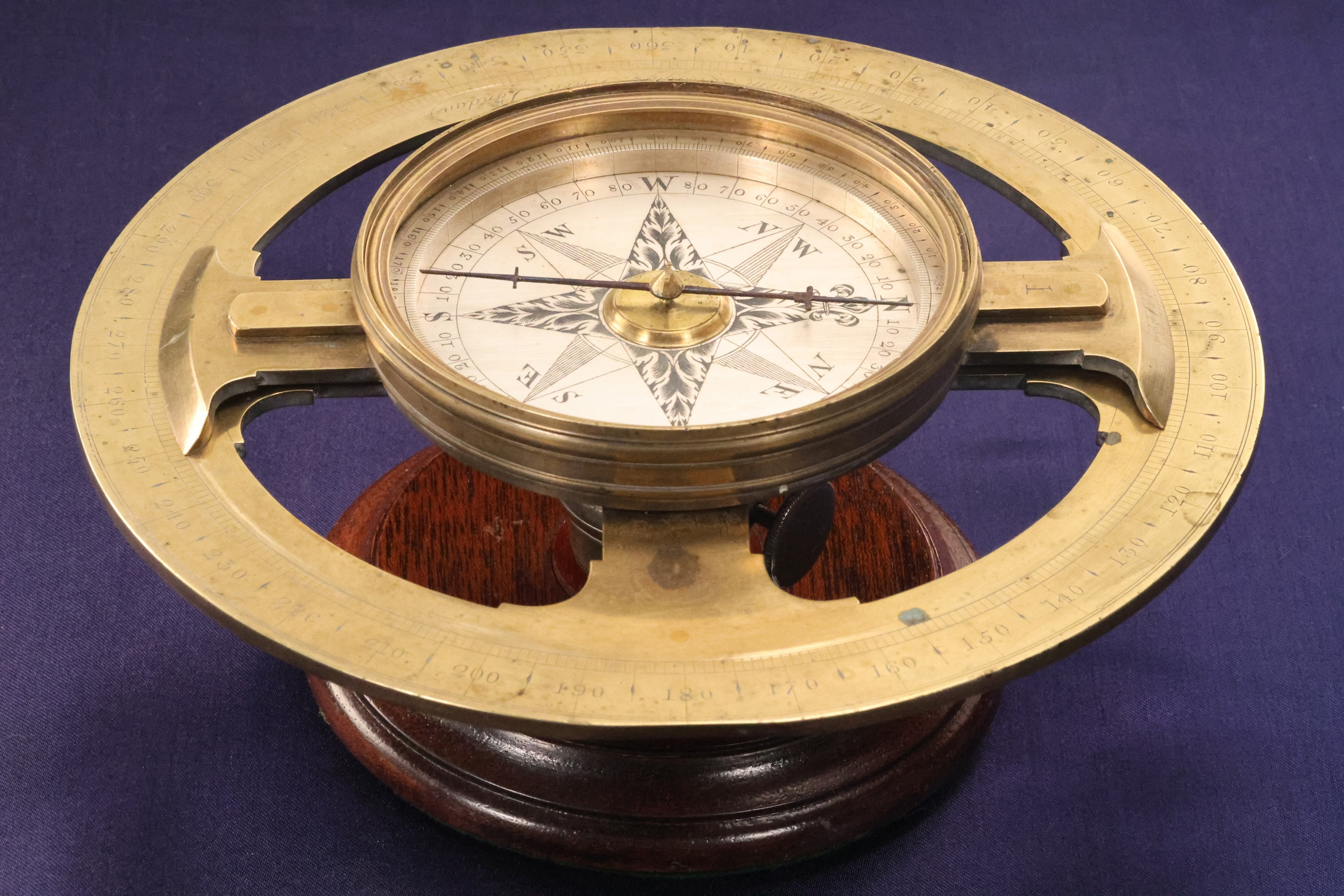
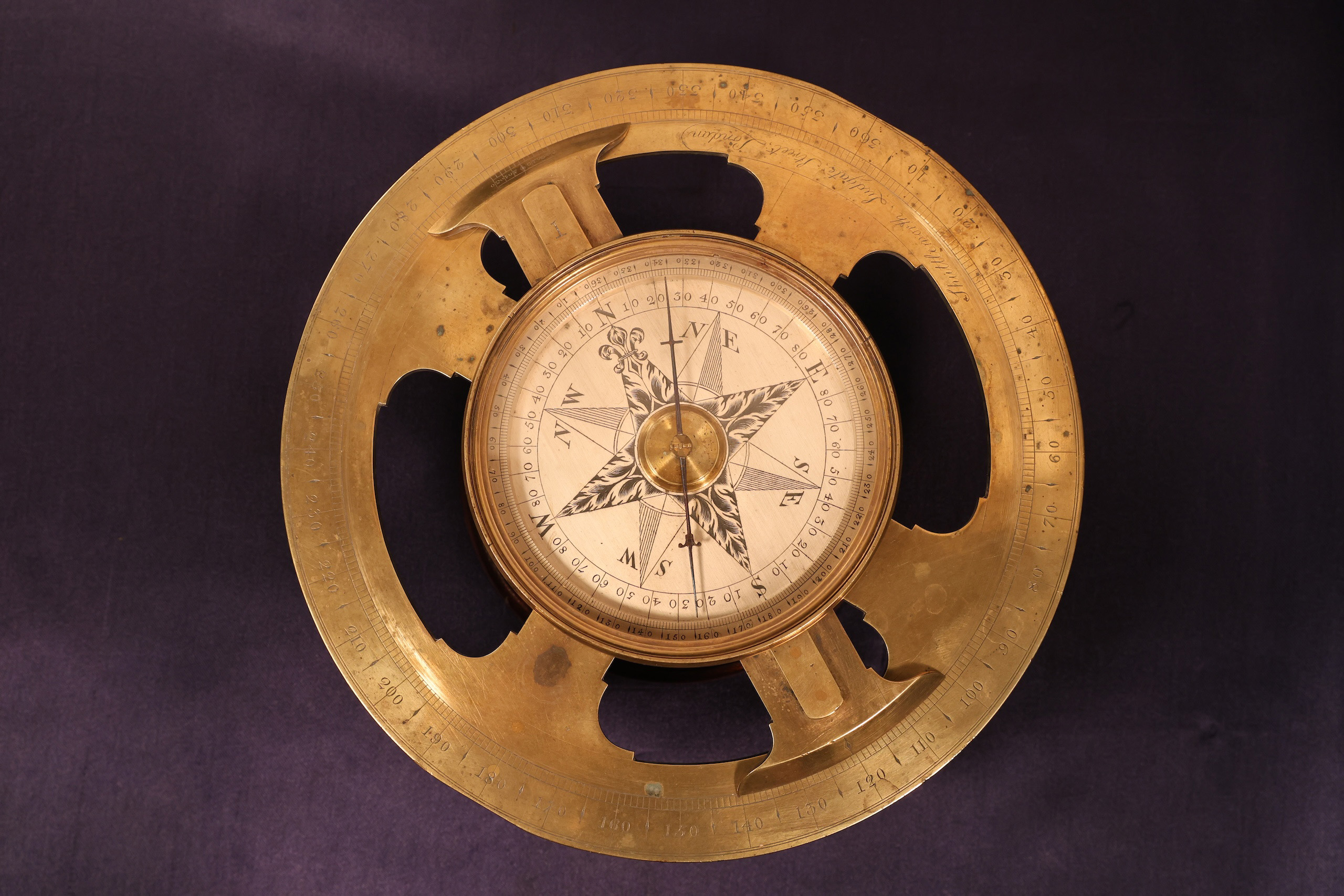
Antique simple theodolite having 4″ hand engraved and decorated silvered compass dial showing cardinals and intercardinals, fleur de lys to north, and quadrant scale 0°-90°-0°-90°-0°. Outer stepped ring displaying 0 – 360° anti-clockwise, divided to 5° and 1° increments. Mid-Georgian pattern blued needle suspended on brass crown pivot. Flat glass contained by a sprung brass bezel.
All within a brass case case fixed to a heavy brass alidade, one angled end displaying a vernier scale with a range 30°-20°-10°-0°-50°-40°-30°, the arm with engraved number “1.” The other angled end with diamond shaped indicator. Twin mounts for removable sights. The alidade set on an 8” diameter brass protractor, the outer edge with a range 0°-360° running clockwise, and marked at the 0°/360° point with the maker’s details in engraved script “Shuttleworth, Ludgate Street, London.” The extreme edge of the protractor at the 0°/360° and 180° points slightly flattened.
The verso fitted with brass stem tube and adjusting screw, set into a bespoke dark polished wood desk stand with baize to underside.
Condition: The compass swinging freely and finding north easily, the dial with signs of ageing, otherwise undamaged, the glass replaced. The alidade moving smoothly, the brass protractor ring with marks and patination commensurate with age and use.
Comments: Sometimes called a circumferenter or circumferentor, this is more correctly known as a simple theodolite. The alidade, and with it the compass dial, rotates whilst the pivot and needle stay still. The mounts enable removable sighting vanes to be fitted. The Science Museum’s collection has a very similar, albeit earlier 18th century, theodolite by John Howard.
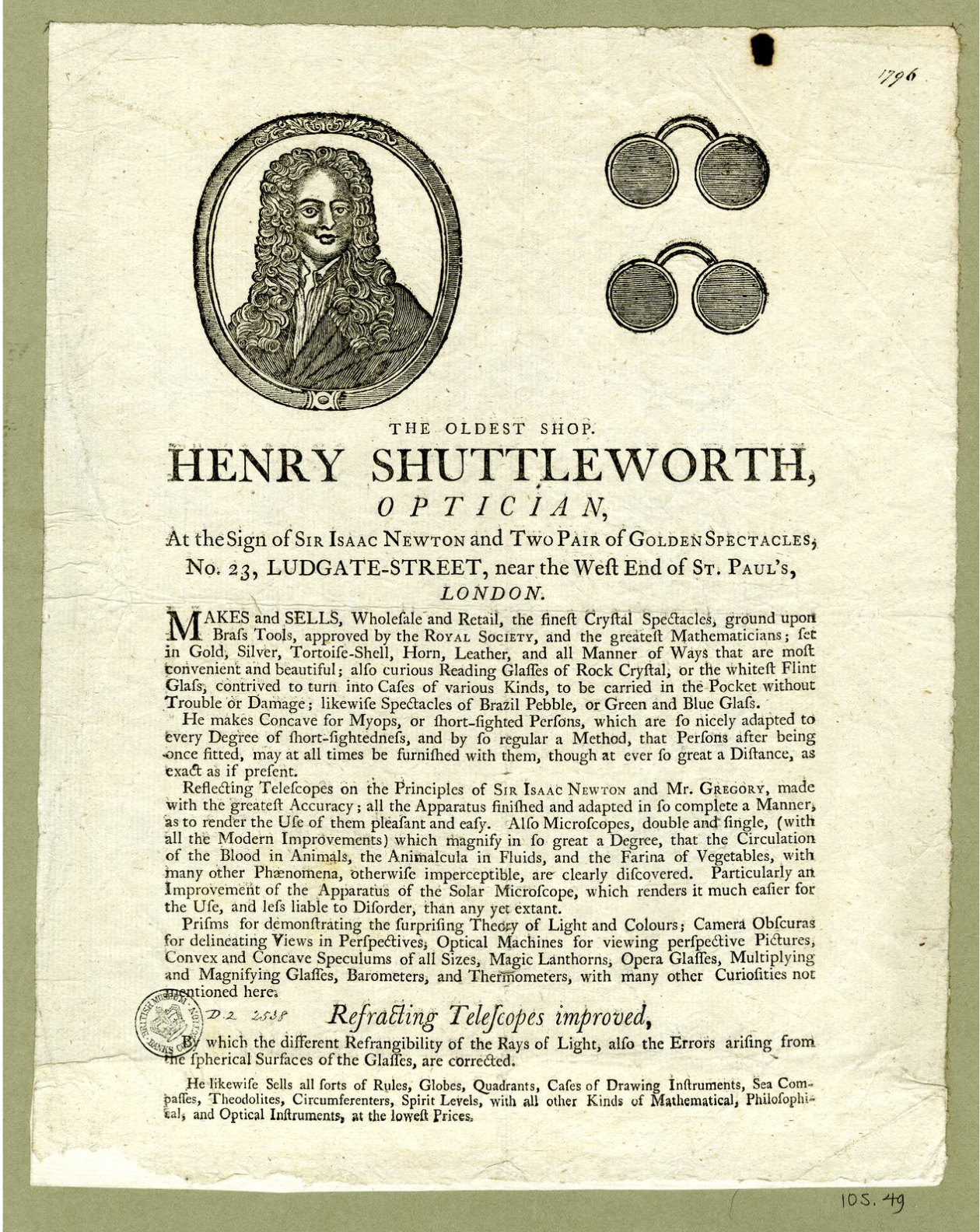
This is a beautiful and interesting instrument, the hand-decorated compass in near fine condition. Henry Raynes Shuttleworth, a respected maker of optical, mathematical and philosophical instruments, is recorded in Gloria Clifton’s Directory of British Scientific Instrument Makers, 1550-1851 as working between 1760 and 1797, and counted the highly regarded compass maker John Bleuler amongst his apprentices. Shuttleworth’s address was originally the brilliantly named “At the Sign of Sir Isaac Newton and Two Pair of Golden Spectacles, near the West End of St Pauls, London.” This address was updated to “Ludgate Street” in 1774, and then to “23 Ludgate Street” in 1780. The trade flyer shown is therefore from the latter part of the 18th century. These days, Ludgate Street has been replaced by the much wider Ludgate Hill, running from St Paul’s Churchyard and Ludgate Circus.
A perfect gift for both the collector of compasses and surveying instruments, and one who simply enjoys the history of Georgian scientific instruments.
Dimensions: 8" diameter x 3½" deep
Stock No: BA3337
Price: SOLD