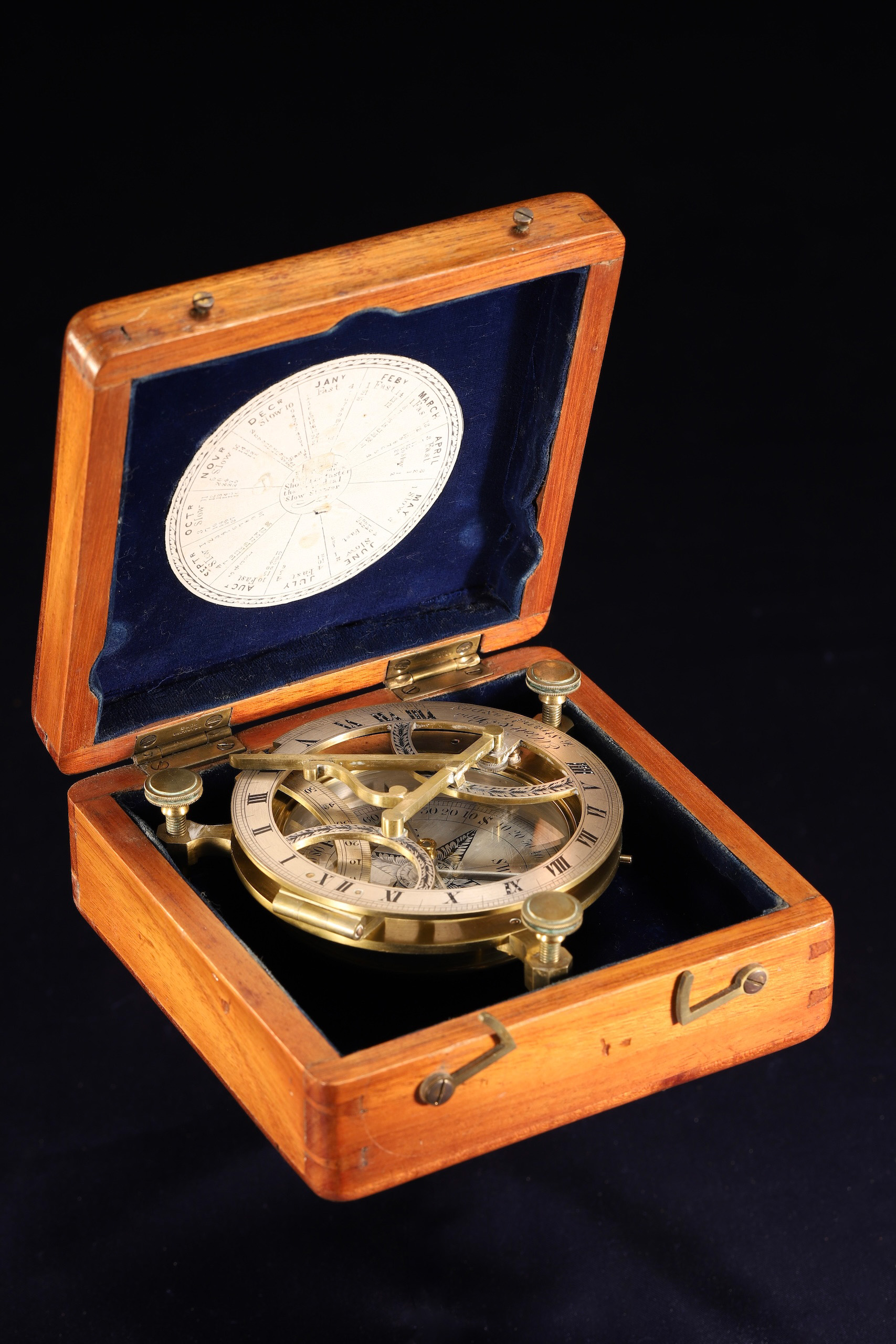
An early Victorian equinoctial sundial compass by Elliott & Sons in original teak travel case, c1850
A fine and rare early equinoctial sundial compass by William Elliott & Sons, 56 Strand, London, made between 1850 and 1853, complete in its original fitted teak travel case with equation of time table.
The trading name and address allow this instrument to be dated with documentary precision. William Elliott & Sons traded at 56 The Strand for three years only — from 1850, when William took his sons Frederick and Charles into partnership, until 1853, when William died and the firm was renamed Elliott Brothers. An instrument signed Elliott & Sons, 56 Strand can be therefore placed within this window with complete confidence.
THE SUNDIAL COMPASS
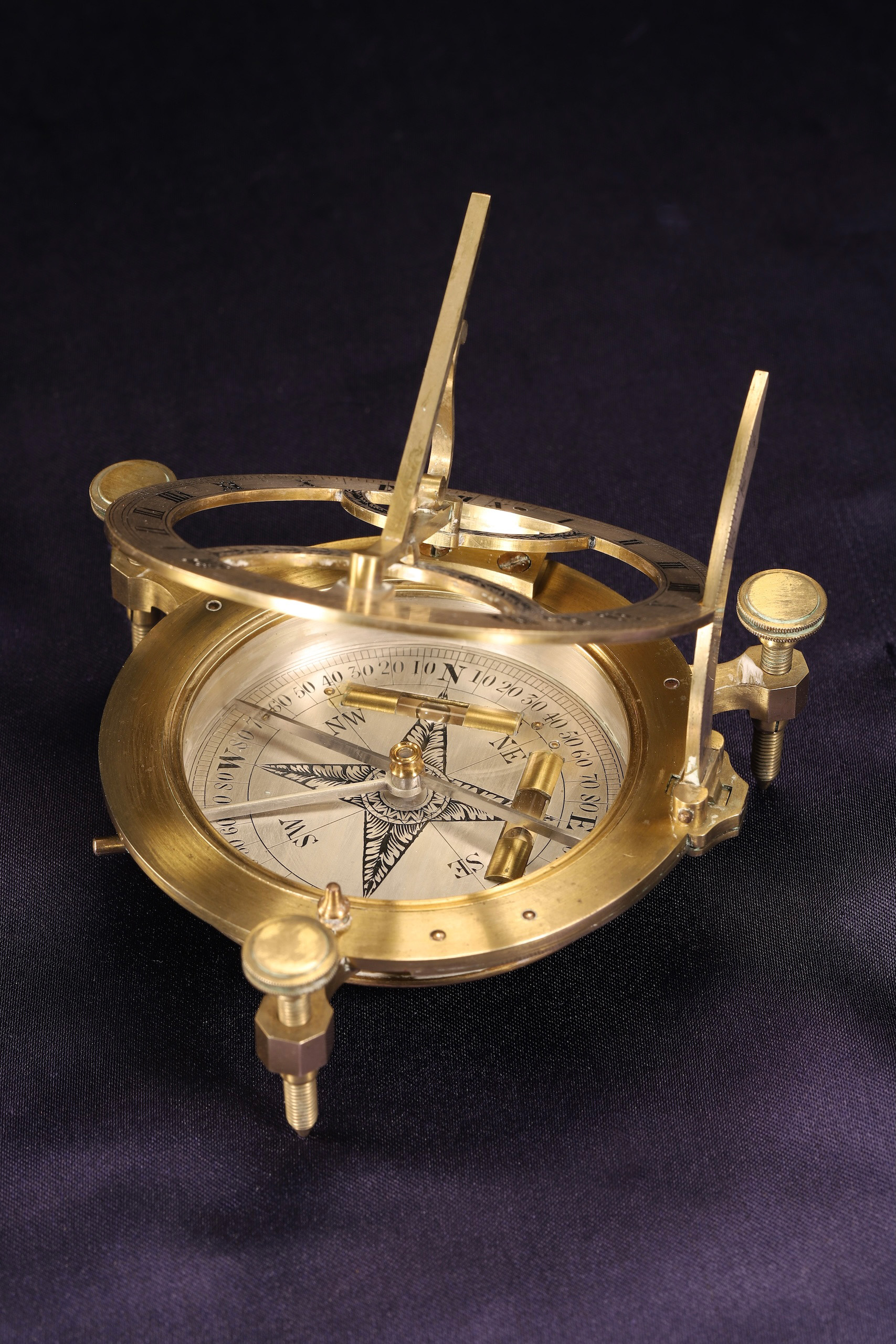
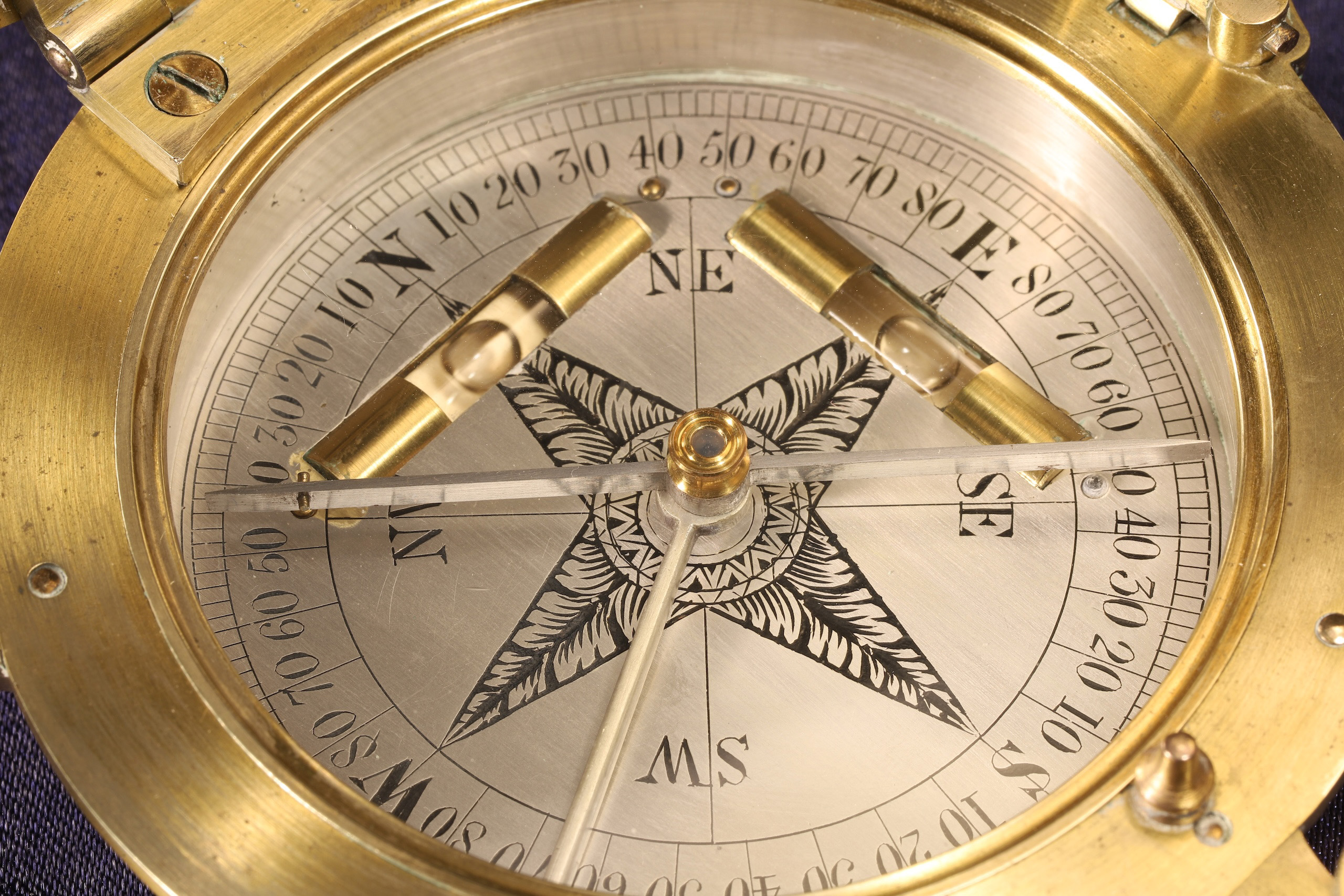
The 2½” compass carries a finely engraved and silvered dial displaying cardinals and intercardinals — the cardinals within the outer quadrant scale running 0°–90°–0°–90°–0°, the intercardinals within a decorative engraved rose of notable quality. Two inset spirit levels, set at right angles north-south and east-west within the compass housing, allow the instrument to be precisely levelled in both axes — a feature found on the more serious examples of this type and indicative of an instrument made for accurate professional use. Fine bar needle on jewelled suspension under flat crystal; brass case with side-mounted transit lock.
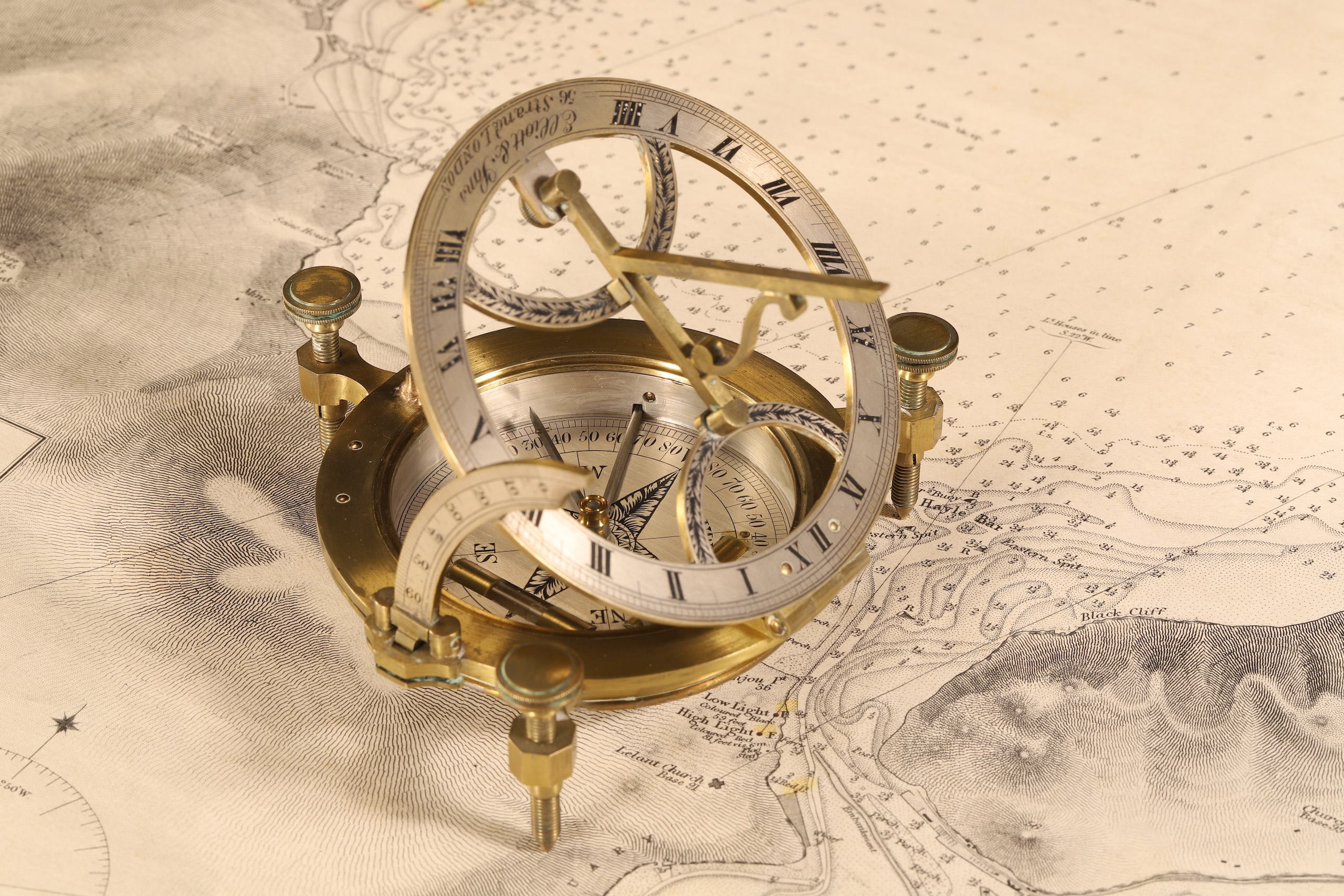
The silvered arc of latitude, calibrated from 0°–60°, is mounted to the side of the case. The 3½” silvered chapter ring is divided and engraved with hours in Roman numerals running clockwise from IIII through noon to VIII, with a decorative feathered border — the maker’s name, Elliott & Sons, 56 Strand, London, engraved to the lower section. The folding lacquered brass gnomon deploys cleanly. Three substantial thumbscrews, mounted to the baseplate, provide fine levelling adjustment on any surface — again a mark of professional specification.
HOW IT WORKS
The equinoctial sundial takes its name from the equinox — the twice-yearly moment when the sun crosses the celestial equator. Unlike a simple horizontal sundial, which works accurately only at a fixed latitude and requires seasonal correction, the equinoctial pattern sets its chapter ring parallel to the plane of the earth’s equator, making it accurate at any time of year.
In use: the spirit levels and three adjusting screws bring the instrument to perfect level. The compass orients it to true north. The latitude arc is set to the observer’s geographic latitude. The chapter ring is raised, the gnomon deployed, and the time read from the shadow it casts on the silvered hour scale. The equation of time table in the lid of the travel case allows the solar time shown by the gnomon to be corrected to mean time — the uniform time kept by clocks, which differs from solar time by up to sixteen minutes depending on the time of year.
THE TRAVEL CASE
The dovetail-jointed teak travel case is an original matched case, made for this specific instrument. Both the base and lid linings are shaped to ensure the instrument sits with complete security in transit. The dark blue velvet linings are bright and well preserved. The inner lid carries the original paper equation of time table, months arranged around the circumference with correction values radiating inward — present and legible, with some fading and minor losses. Twin brass swinging catches; green felt to the underside.
WILLIAM ELLIOTT & SONS
William Elliott established his instrument business around 1804 and built it steadily through several London addresses, manufacturing drawing instruments, telescopes, barometers and scientific instruments of all kinds. In 1850 he took his two sons, Frederick Henry and Charles Alfred, into partnership at 56 The Strand, trading as William Elliott & Sons. In 1851 the firm exhibited at the Great Exhibition, where they were awarded a Bronze Medal.
William died in 1853, his sons continuing as Elliott Brothers. The firm subsequently absorbed the renowned Watkins & Hill in 1857, manufactured electrical and telegraphic instruments for the Admiralty and Royal Navy, was awarded the Royal Warrant in 1902, and ultimately — through a series of mergers — became part of BAE Systems, one of the longest and most distinguished lineages in British instrument making.
CONDITION
The instrument is crisp throughout. The compass dial is clear and well preserved; the decorative rose is sharply engraved; the needle finds north easily; the transit lock works correctly; the arc and gnomon articulate cleanly. The brass case retains much of its original lacquered finish. The chapter ring and arc retain almost all of their original silvering, with some marks and honest wear consistent with age and use. The spirit levels are present and functional.
The teak travel case is in very good condition, with a few marks and minor losses consistent with age and use, and very slight warping to the front edge. The dark blue velvet linings are bright; the equation of time table is present with some fading and minor losses; the green felt to the underside is sound.
NOTE ON SIZE
This instrument is notably substantial — the compass at 2½” diameter, the chapter ring at 3½”, and the overall footprint with levelling screws deployed giving it presence. Most equinoctial sundial compasses found in original cases are smaller in scale – this example impresses as a larger than typical representative of the type.
Dimensions: 5⅛” wide x 5⅛” deep x 2¼″ deep
Stock No: SI3186
Price: SOLD