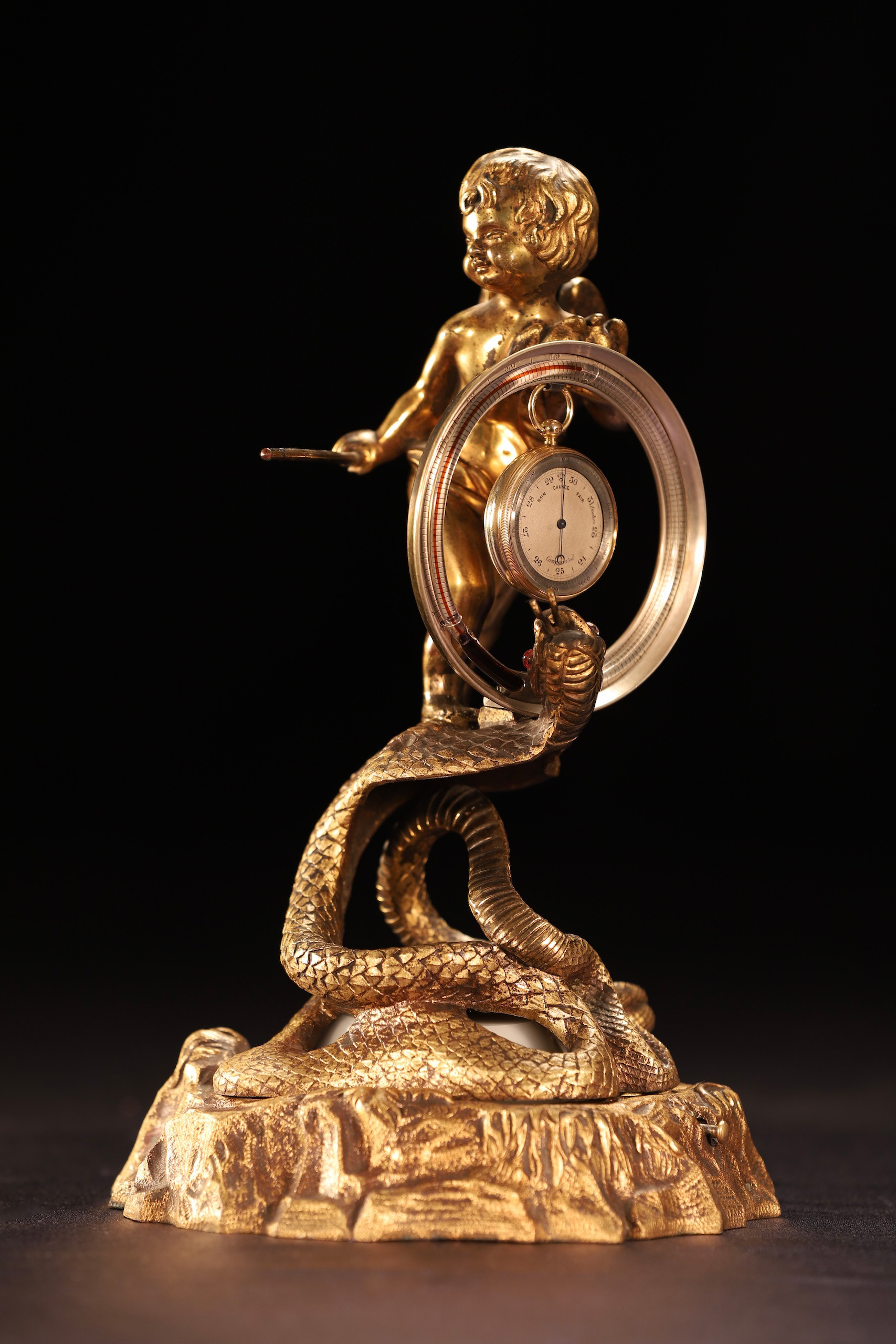
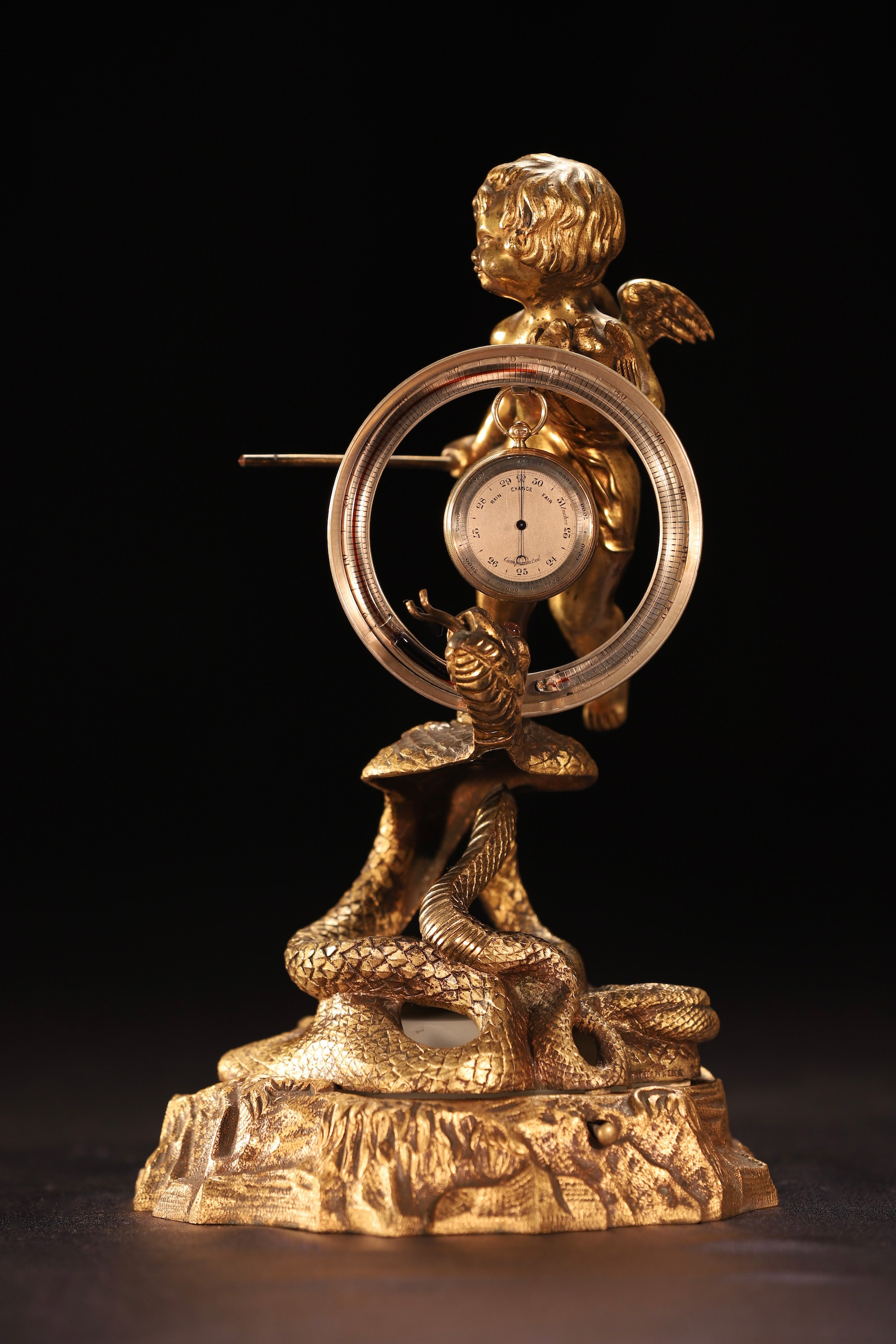
A rare ormolu gilt bronze cobra inkwell and desk compendium by Benjamin Waterhouse Hawkins, published 1850, with 18ct gold miniature pocket barometer c1870
Some objects are decorative. Some are functional. Very occasionally, an object is simultaneously a work of art, a scientific instrument, a piece of publishing history, and a document of one of the most remarkable careers in Victorian natural history. This is one of those objects.
Designed and published by Benjamin Waterhouse Hawkins in early 1850 — the year before he took up his role as assistant superintendent of the Great Exhibition, and two years before he began the Crystal Palace dinosaur sculptures that would make his name — this gilt bronze cobra inkwell and desk compendium is among the most ambitious and accomplished decorative objects of its period. It combines the eye of a natural history artist of the first rank with the hand of a sculptor at the height of his powers, and the result is an object that stops a room.
We know of only four examples. This is the finest.
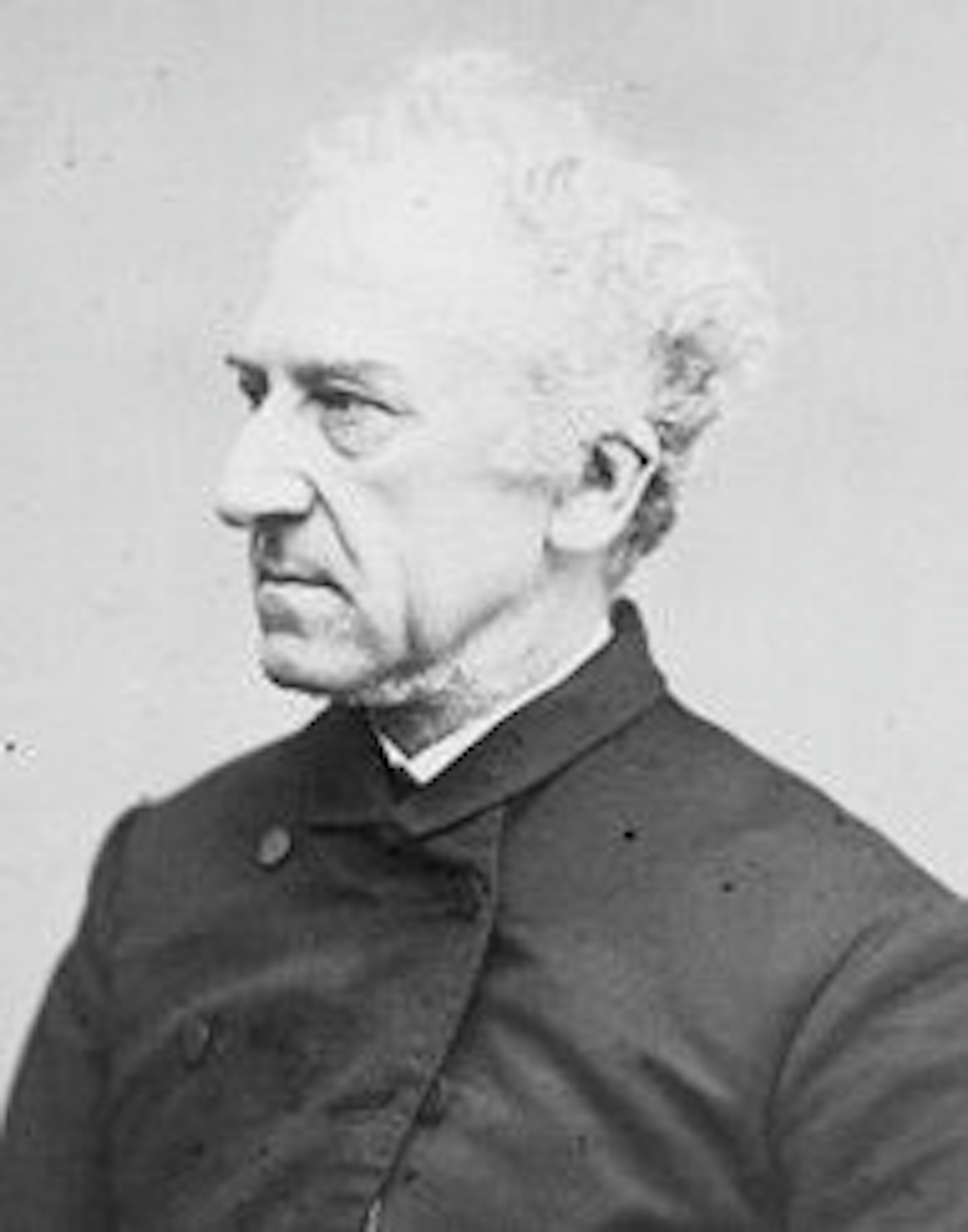
BENJAMIN WATERHOUSE HAWKINS (1807–1894)
Benjamin Waterhouse Hawkins was one of the defining figures of Victorian natural history art and sculpture. Trained under the sculptor William Behnes, he spent the 1840s producing studies of living animals at Knowsley Park for the Earl of Derby — work that established his reputation for anatomical precision and naturalistic observation. He contributed illustrations to Charles Darwin’s Zoology of the Voyage of HMS Beagle, exhibited at the Royal Academy, and was elected to the Linnean and Geological Societies.
In 1851 he served as assistant superintendent of the Great Exhibition. The following year he was commissioned by the Crystal Palace Company, working alongside Sir Richard Owen, to create thirty-three life-size models of prehistoric animals for Crystal Palace Park — the first ever attempt to reconstruct extinct creatures in full-scale, three-dimensional form. The famous New Year’s Eve dinner of 1853, held inside the mould of an Iguanodon, was characteristic of the man: theatrical, scientifically serious, and impossible to ignore.
This cobra inkwell was published in February and March 1850 — at the peak of Hawkins’ pre-Exhibition career, in the year he was preparing for the most significant public role of his life. The Wikipedia article on Hawkins lists this piece — described as Bronze cobra inkwell with compass, Published 1850 — within his documented body of work, alongside a reference to sculpture work for the Coalbrookdale Company as exhibited at the 1851 Great Exhibition. Whether this specific design formed part of that Great Exhibition connection remains a matter of ongoing research, but the timing and the context are compelling.
THE PUBLISHED DESIGN
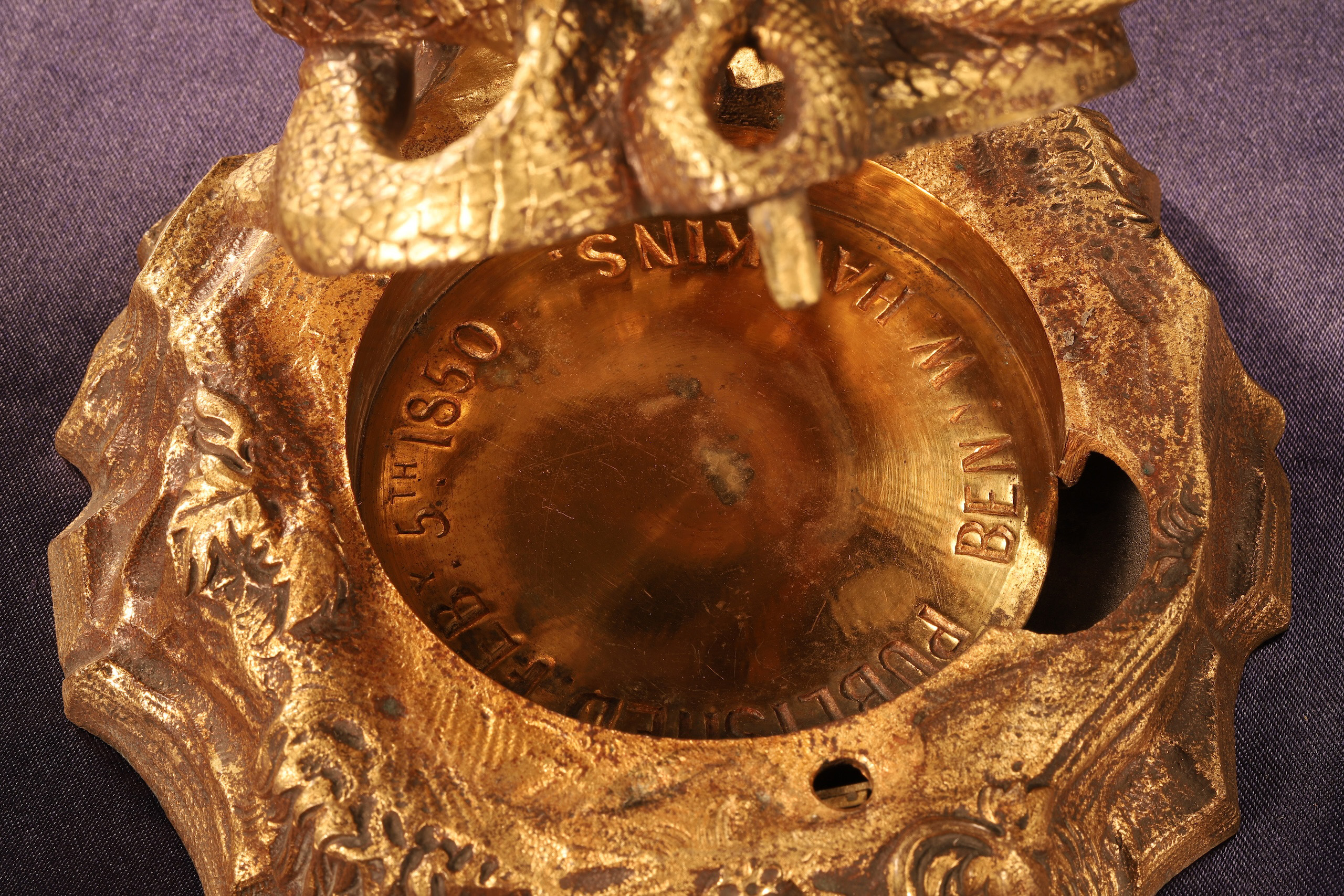
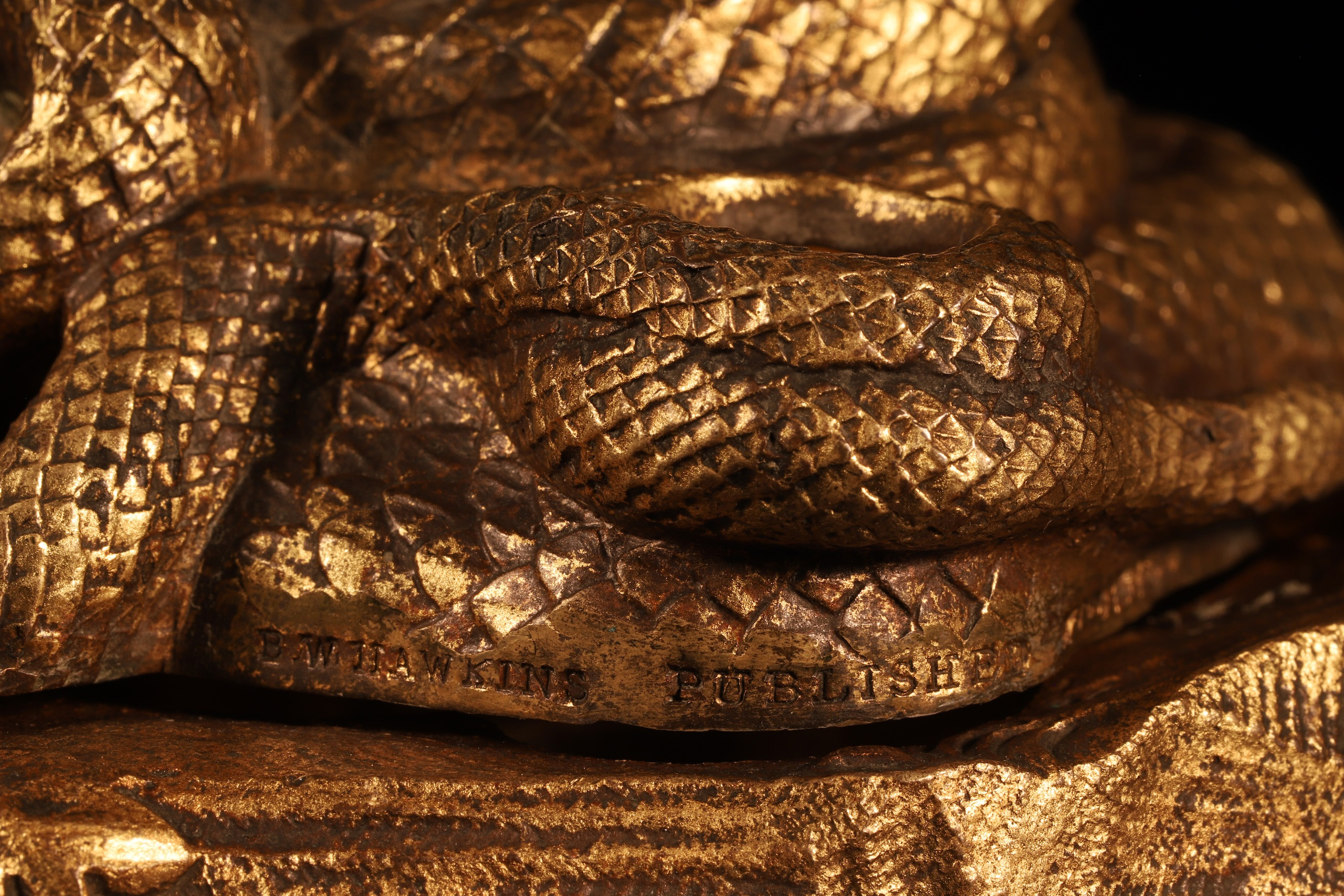
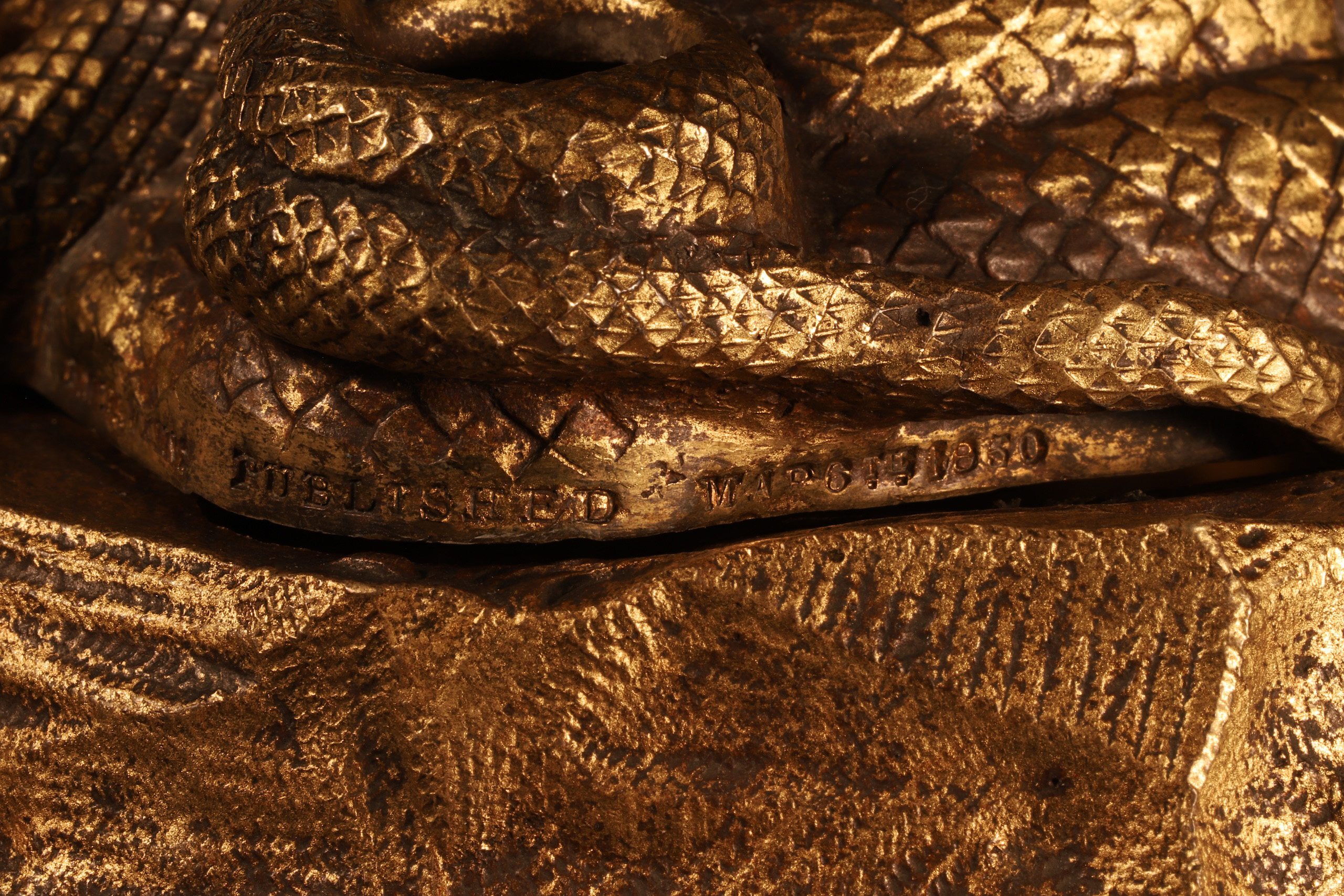
The inscriptions cast into the metal are among the most distinctive features of this piece — and among the most revealing. Victorian copyright practice for prints and illustrations required that published works carry the maker’s name and date. Hawkins applied exactly this convention to a three-dimensional cast object, the Published notation and dates forming an integral part of the original casting rather than a subsequent addition.
Two separate publication dates appear on this piece:
Inside the inkwell cavity: Ben.n. W. Hawkins Published 5th Feby 1850
Around the bottom edge of the upper casting: B.W. Hawkins Published Mar 6th 1850
The month between the two dates most probably reflects the separate publication of two distinct design elements — the overall composition and a specific component — each registered independently in the manner of a printed design series. This is a practice more commonly associated with the print trade than with three-dimensional sculpture, and its application here speaks directly to Hawkins’ background as an illustrator and his sophisticated understanding of Victorian intellectual property practice.
THE OBJECT
A gilt bronze cobra desk compendium, designed and published by Benjamin Waterhouse Hawkins, 1850. Offered together with an 18 carat gold miniature pocket barometer altimeter, c1870.
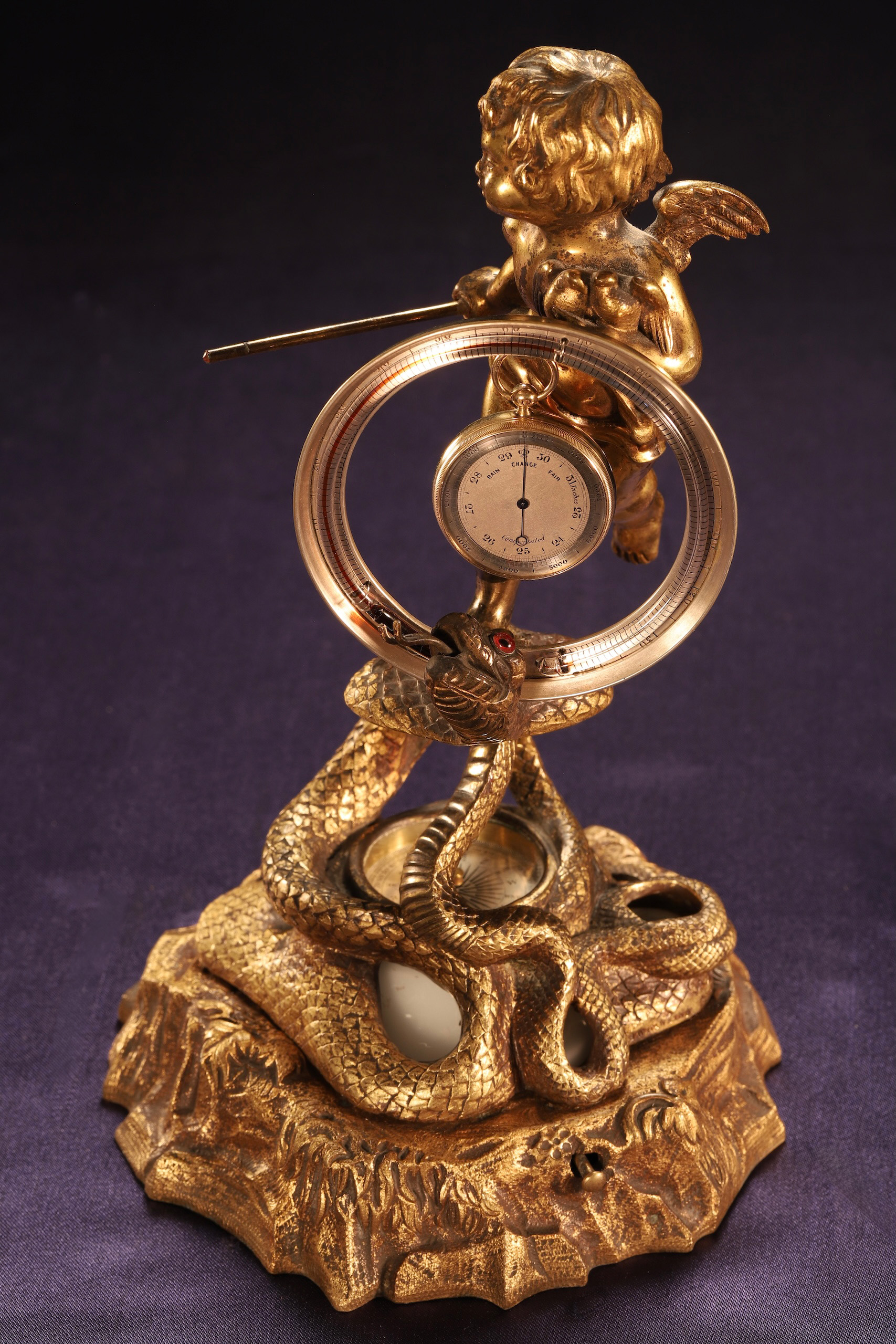
The composition rises from a naturalistically modelled rocky base — cast with extraordinary attention to detail, the texture of stone and vegetation rendered with the hand of a natural history artist — from which a coiled cobra ascends in a continuous spiral of superbly observed scales, each one individually defined. The cobra’s head is raised, the eyes set with red glass, the expression alert and watchful. Atop the cobra stands a gilded putto or cherub, winged, one hand holding a pen or stylus, the figure modelled with the confidence and anatomical fluency one would expect from a sculptor trained in the classical tradition and steeped in the observation of living forms.
Three instruments are integrated into the composition with complete naturalness:
The alcohol thermometer — identified by the characteristic red column of its fluid, echoing the cobra’s red eyes — forms a circular ring held against the putto’s body, the scale with a range of 0°-140°F visible around the circumference. Within this ring, suspended on its bow, hangs the miniature pocket barometer — of which more below.
The Francis Barker 1½” compass with decorative rose displaying cardinals, intercardinals and false points, and a blued steel needle marked N and S in gilt, is fitted within the coils of the cobra at the base of the composition. Francis Barker, who established his business in 1848 and went on to become the preeminent British compass maker of the Victorian and Edwardian eras, was the dominant white label supplier to the instrument trade — his compasses appearing under many names, or none. This example, dated by us to approximately 1860 and possibly earlier, sits correctly and securely in its mount — unlike the replacement compasses found in two of the other three known examples.
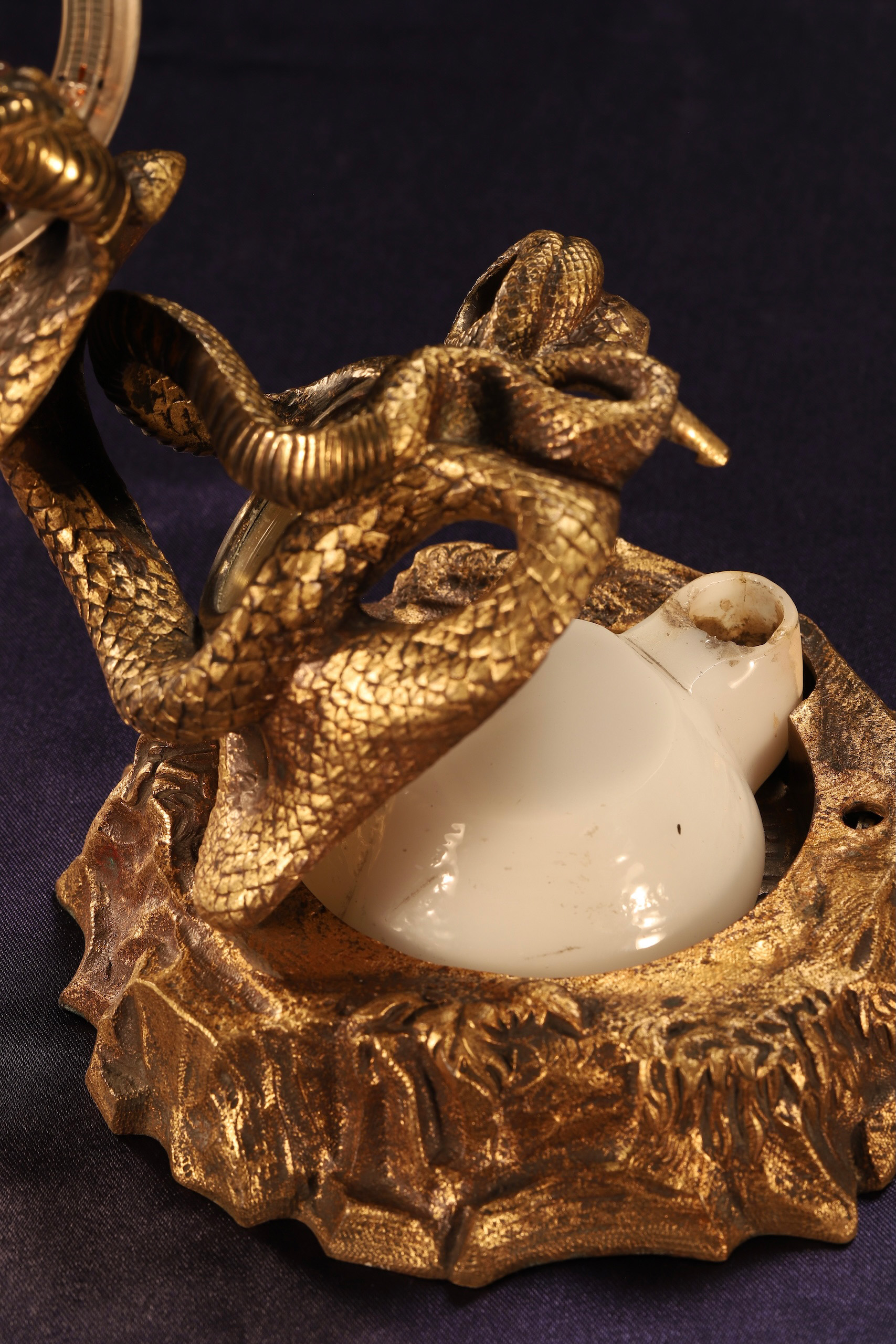
The original porcelain inkwell sits within the coils of the cobra at the base, white and intact — repaired at some point in its history, but present. Of the four known examples of this piece, only one other retains its inkwell. Its presence here is a significant distinction.
We note with interest that the white porcelain of the inkwell, visible through the coils of the cobra as the piece is viewed from certain angles, has the appearance of eggs — and that a cobra coiled around eggs is an image with deep roots in natural history illustration of exactly the period in which Hawkins was working. Whether this is intentional on Hawkins’ part we cannot say with certainty, but it is a detail entirely consistent with the mind of a man who spent decades thinking carefully about the representation of animal life.
The base retains its original fine felted covering, intact and sound.
Material: Almost certainly bronze, gilded. The quality and depth of the casting, and the original gilded finish — which retains its warmth, its patina, and its variation in tone across the surface — is consistent with high quality Victorian bronze founding. We have not been able to confirm this definitively without invasive testing, which we have chosen not to undertake.
THE MINIATURE 18 CARAT GOLD POCKET BAROMETER (c1870)
This piece is offered together with a particularly fine 18 carat gold miniature aneroid pocket barometer altimeter, stock number PB0962, which is also available separately on our website, and is described fully HERE.
We should be clear: the barometer did not come with this inkwell originally. The suspension hook on the thermometer ring was almost certainly designed to hold a pocket watch — pocket barometers not having been invented until 1864, some fourteen years after the inkwell’s publication. It is equally possible, however, that the whole piece was manufactured in the 1860s to Hawkins’ 1850 design — in which case a pocket barometer would have been entirely contemporary. We cannot resolve this question with the evidence currently available, and we present it honestly as an open one.
What we can say is that the gold barometer, suspended within the thermometer ring, is a visually and conceptually perfect companion to this piece — a combination of scientific instruments and decorative sculpture that is entirely in the spirit of the original design.
CONDITION
The piece retains much of its original gilded finish — the warmth, depth and variation in tone of original Victorian gilding.The casting is crisp throughout; the cobra’s scales retain their individual definition; the putto is well modelled and undamaged. The red glass eyes of the cobra are present and intact. The original felt base is present and sound.
The inkwell has been repaired at some point — a small loss visible — but is present and structurally sound. The compass is working correctly. The thermometer ring is intact with the alcohol column visible. The overall condition, for a piece of this age, ambition and rarity, is genuinely impressive.
THE FOUR KNOWN EXAMPLES
To the best of our research, only four examples of this design are currently known:
This example — putto variant, original gilding, original inkwell (repaired), original Francis Barker compass correctly fitted, original felt base, both publication dates confirmed. The finest known example.
A second putto variant, though that is lacking its inkwell and has a relatively modern replacement compass
A crystal ball variant in place of the putto, original Barker compass identical to ours correctly fitted. This represents the alternative top element configuration of the design and is featured on the Wikipedia page about Hawkins.
A second crystal ball variant, lacking its inkwell and with an early 20th century replacement compass.
The existence of both putto and crystal ball variants — published within weeks of each other in early 1850 — suggests that Hawkins designed this as a modular composition, with the upper element available in at least two configurations. Whether other variants exist remains unknown.
A NOTE ON PROVENANCE AND ONGOING RESEARCH
The Wikipedia article on Benjamin Waterhouse Hawkins lists the cobra inkwell within his documented body of work and references a connection between his sculpture designs and the Coalbrookdale Company as exhibited at the 1851 Great Exhibition. Whether this specific piece formed part of that exhibition connection is a matter we are actively researching. We will update this listing as our research progresses.
Dimensions: 5½” wide x 9¾″ high x 6" deep
Stock No: CP3182
Price with barometer: £2750; price without barometer: £2000