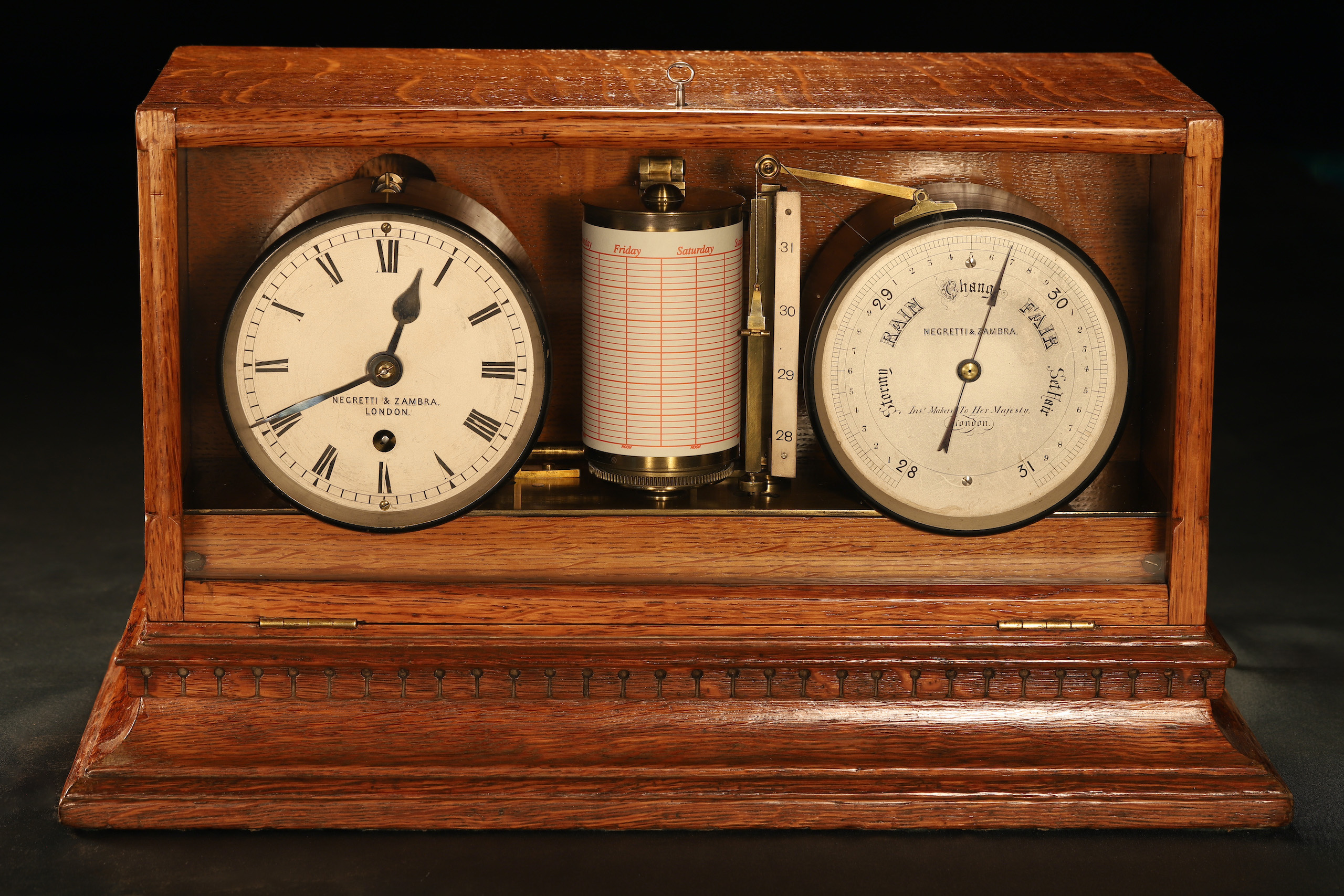

A good and very early medium light oak cased demi weather station by Negretti & Zambra c1868
Weather station comprising 8 day chain fusee clock with deadbeat escapement, the 4½” silvered dial marked with Roman numerals, spade hands, aperture with winding square, the lower part signed by the maker “Negretti & Zambra.” Actuators for barometer prompt and barograph registration system, worm and wheel drive to barograph drum. Mounted within a drum form Japanned shroud.
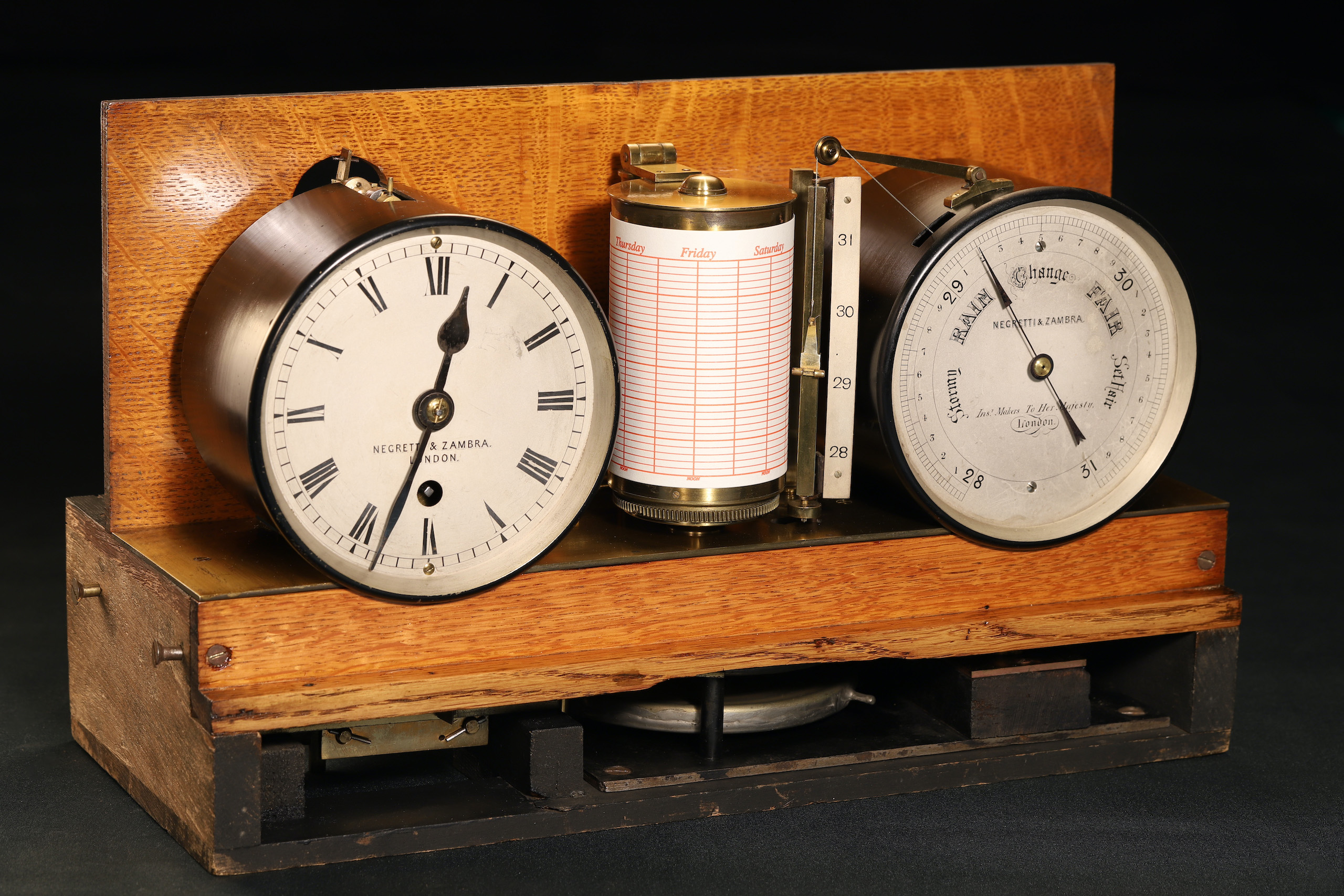
The 4½” silvered and die struck barometer dial calibrated in inches of mercury with a range from 28” – 31” divided down to 1/50th, standard meteorological terms, the upper part signed by the maker “Negretti & Zambra,” the lower part marked “Instrument Makers to her Majesty,” blued steel ‘arrow’ pointer. Mounted within a japanned drum form shroud. The massive movement contained within the lower plinth and comprising twin 4¾” soldered nickel alloy soldered capsules, the substantial cast iron bridge acting on a coil spring, motive force transmitted to pointer arbor via levers and fine chain.
The ‘demi’ recording drum 4” x2½” with internally sprung paper tension levers and clips, the lower circumference with driven gear, freely revolving on a circular base with rear column mounted hinged securing lid. The marker system comprising a vertical register marked with inches Hg, pen carrier or carriage drawn vertically by chain from the barometer maintained on a vertical guide, the whole caused by function of the clock to rotate to the circumference of the chart on the ½ hour. The barometer prompt striking on the ¼ hour.
The barometer movement contained within a timber frame, the top surfaces with lacquered brass trim plates. The whole contained within a lacquered medium light quarter sawn oak case, drop down glazed front panel with lock over, rear hinged inspection door with securing catch to clock movement. Barometer adjustment square from case bottom.
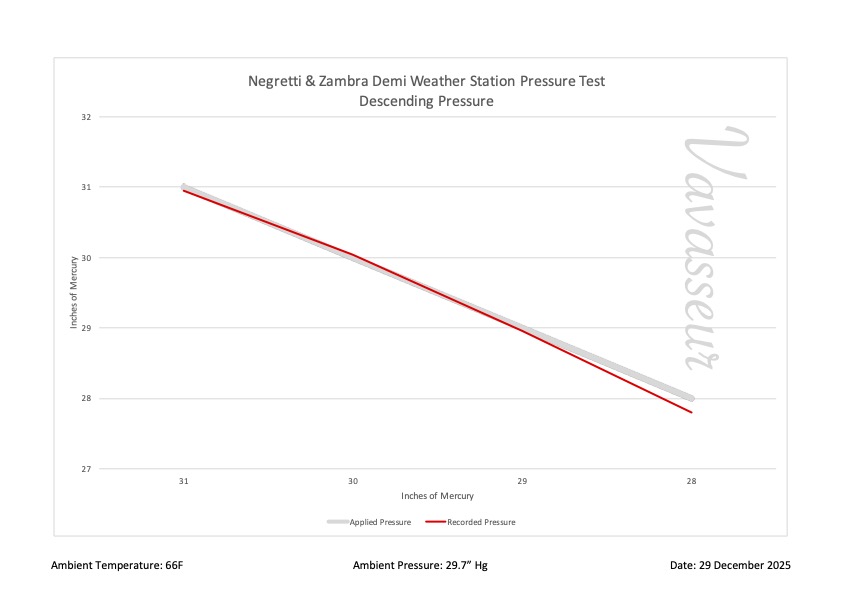
Condition: The barometer the subject of a full service, conservation, and calibration under laboratory conditions, see performance chart from dynamic test. The clock movement professionally serviced. Both instruments working exceptionally well, the clock keeping very good time, the barometer with accuracy better than 1/10th across the normal range.
Both clock and barometer dials with some ageing and minor marks. The lacquered brass work retaining very much of its original finish with good colour. The timber case correctly re-polished.
Comments: The basic design of this instrument probably dates back to 1865 or slightly later. It would appear that there are two very distinct designs and probably four variations, the earliest single capsule and slightly later double capsule types with the barometer movement mounted within a timber frame below the barometer dial, and later versions in which the barometer movement was mounted within a shroud behind the barometer dial. Those types with barometer mounted behind the dial appeared with two and four capsules tensioned on both coil and C springs.
It is interesting to note the progression in design particularly in relation to the numbers of capsules, the rationale being that the more capsules added, the greater the motive force the movement could generate. This development was made to address the inherent shortcomings in the movement brought about by friction and the attempts made to overcome this, thus increasing accuracy and response to pressure change. The rapidly changing design and development of this instrument can be seen by the inclusion of a wooden block mounted below the twin square columns supporting the arbor, this almost certainly a fairly hasty modification made in order to accommodate the increased height of the movement owing to the addition of an extra capsule.
It is likely that the early movements and possibly some of the those earlier versions of behind the dial movements were made for Negretti & Zambra by Callaghan, maker of the majority of, if not all movements in the larger full sized weather stations.
Reviewing our records, I have seen or worked on just four of these demi weather stations, two of which we currently hold here. See the later Negretti & Zambra version held in our Archive HERE. Numbers produced, based on those known to exist, would suggest low volume production of perhaps a few hundred only.
From a collector and user’s perspective, this is a very attractive proposition based on its appreciably smaller size and overall its rather better performance which as mentioned earlier has much to do with its substantially lighter component parts and associated reductions in static and dynamic friction. All things considered, these do work better.
The chart marking system not shown working (though it does work) is simple: originally these instruments were supplied with a special paper having a distinctly abrasive surface, the marker itself a short copper rod maintained within the marker carriage that runs vertically up and down the registration bar. This system is easily modified with the use of a normal textured paper and a short soft graphite rod as the marker.
In all a very attractive, functional and unusual instrument in well above average and original condition. Very much for the collector connoisseur.
Dimensions: 19" wide x 11" high x 9" deep
Stock No: BG2901
Price: Vavasseur Archive - not currently for sale